
The difference between Hafs and Warsh Quran is a common topic among Quran learners who want to understand why some Muslims recite certain verses with slightly different pronunciations and rhythms. Although these variations may sound different to listeners, they represent authentic methods of Quran recitation that have been preserved carefully throughout Islamic history.
Many students who begin learning the Holy Quran ask whether Hafs and Warsh are two different versions of the Quran or whether these recitations have different meanings. However, the truth is that both are authentic narrations of the same Quran that was revealed to Prophet Muhammad ﷺ.
The differences between Hafs and Warsh mainly appear in pronunciation, Tajweed rules, vowel sounds, elongation methods, and some linguistic details. Therefore, understanding these differences helps Muslims appreciate the beauty of Quranic sciences and the careful efforts of scholars who transmitted the Quran from one generation to another.
Moreover, learning about these recitations gives students a deeper understanding of how the Quran has been preserved with accuracy and precision. Whether a person learns Hafs or Warsh, they are learning the same divine message with the same beliefs, guidance, and teachings.
This complete guide explains the history, rules, examples, and learning methods related to Hafs and Warsh while answering the most important questions that Quran students usually ask.
What Is the Difference Between Hafs and Warsh Quran Recitations?
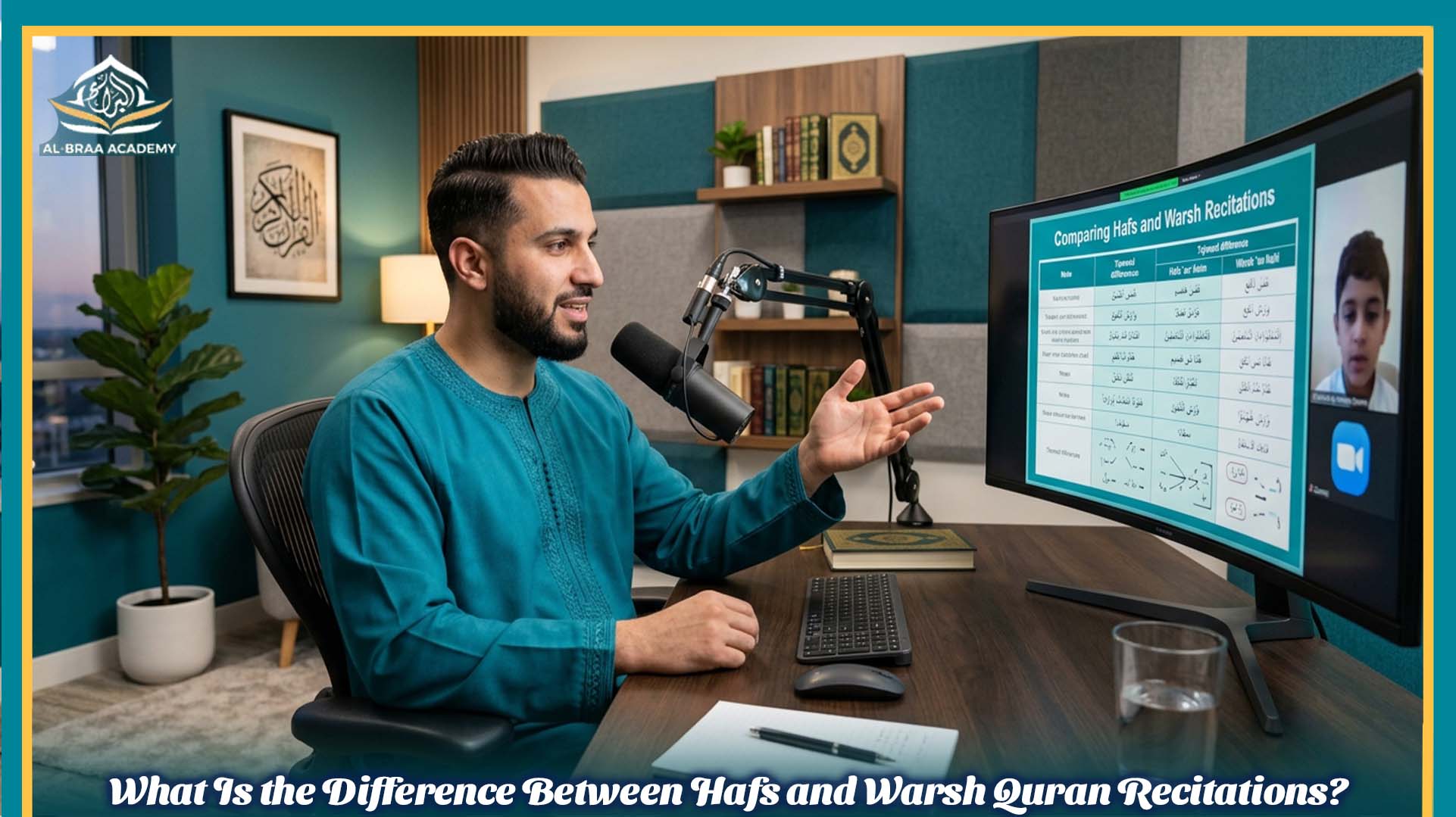
To understand the Difference Between Hafs and Warsh Quran, we first need to understand the meaning of Quranic recitations and how they were transmitted.
Quran recitation, known as Qira’at, refers to the different authentic ways of reading the Quran that were taught through reliable chains of teachers and students. These readings were passed from the Prophet Muhammad ﷺ to his companions and then continued through generations of Quran scholars.
The science of Qira’at developed because Arabic has a rich linguistic structure that allows different accepted pronunciations while maintaining the same meaning and message.
Among the ten authentic Quran recitations recognized by scholars, Hafs and Warsh are among the most famous and widely practiced. The two main narrations are:
- Hafs ‘an Asim
- Warsh ‘an Nafi’
Both narrations follow strict rules of transmission and Tajweed. In addition, both have strong scholarly foundations that confirm their authenticity.
They are not separate Qurans. Instead, they are different methods of reciting the same Quranic text.
Start Your Quran Journey With Al Braa Quran Academy Today
If you are ready to begin a meaningful journey with the Holy Quran, Al Braa Quran Academy is here to guide you step by step. Our qualified teachers help you improve your Quran recitation, understand Tajweed rules, and build strong confidence in reading the Quran correctly.
Moreover, you can join flexible online classes designed to suit all ages and learning levels. As a result, you can learn at your own pace while maintaining consistency and focus. In addition, our structured lessons ensure steady progress and a clear understanding. Start today and take the first step toward mastering Quran reading with clarity, consistency, and a strong spiritual connection.

Hafs ‘an Asim Recitation Explained
Hafs ‘an Asim is the most widespread Quran recitation style in the world today. Millions of Muslims learn and memorize the Quran using this narration because most printed Mushafs and digital Quran applications follow the Hafs reading.
The narration was transmitted through:
- Hafs ibn Sulayman
- Imam Asim ibn Abi Al-Najud
- The companions of Prophet Muhammad ﷺ
Furthermore, Hafs became especially common in many Muslim countries, including:
- Egypt
- Saudi Arabia
- Turkey
- Pakistan
- India
- Indonesia
- Malaysia
- Many international Quran learning communities
Because of its global availability, most beginners encounter Hafs when they start reading the Quran. In addition, many online Quran teachers use Hafs as the primary recitation for new students.
Hafs is known for its clear pronunciation and straightforward Tajweed application, which makes it suitable for beginners and advanced learners alike.
Warsh ‘an Nafi’ Recitation Explained
Warsh ‘an Nafi’ is another authentic Quranic narration that has been preserved through a strong chain of Quran scholars.
This narration comes from:
- Warsh
- Imam Nafi’ of Madinah
- Earlier Quran teachers who transmitted the recitation
Warsh is especially popular in North and West Africa, where many Muslim communities have maintained this tradition for centuries.
Countries where Warsh is commonly practiced include:
- Morocco
- Algeria
- Tunisia
- Mauritania
- Parts of Libya
- Several regions in West Africa
Furthermore, many Quran students in these areas memorize the entire Quran using Warsh from a young age because local Quran schools continue teaching this narration.
Although Warsh may sound different from Hafs, it follows the same Quranic text and represents a respected method of Quran recitation.
Why Do Different Quran Recitations Exist in Islam?
Many beginners wonder why Muslims have different ways of reciting the Quran. Therefore, understanding the history of Qira’at helps answer this important question.
The Prophet Muhammad ﷺ taught the Quran to his companions using different accepted forms of recitation. These forms helped various Arab tribes read and memorize the Quran according to their linguistic abilities.
However, these variations never changed the main message of the Quran. Instead, they reflected the flexibility and richness of the Arabic language.
Over time, Quran scholars created detailed systems to preserve each authentic reading. Every accepted Qira’ah needed to meet important conditions, including:
- A reliable chain of transmission from qualified teachers.
- Agreement with the Arabic language rules.
- Compatibility with the Uthmani script of the Quran.
Therefore, Hafs and Warsh represent examples of the remarkable preservation of Quranic knowledge.
Main Difference Between Hafs and Warsh Quran Explained
The Difference Between Hafs and Warsh Quran appears in several technical areas related to Quran pronunciation and recitation.
These differences include:
- Tajweed rules.
- Vowel pronunciation.
- Madd and elongation.
- Hamzah treatment.
- Stopping and starting rules.
- Some word pronunciation patterns.
However, these differences do not affect the message, beliefs, or teachings of the Quran.
Instead, they show the depth of Quranic sciences and the careful methods used by scholars to preserve every detail of recitation.
Difference Between Hafs and Warsh Quran in Pronunciation Rules
One of the most noticeable differences between Hafs and Warsh appears in pronunciation.
Imalah in Hafs and Warsh Recitation
Imalah refers to slightly changing the vowel sound between the Arabic sounds of “a” and “e.”
In some Quranic words, Warsh applies the rule of Imalah, while Hafs usually maintains the normal vowel pronunciation.
As a result, listeners may notice a different sound when hearing the same verse recited by Hafs and Warsh readers.
However, the written Quran remains the same, and the meaning does not change.
Pronunciation of the Letter Ra (ر)
The pronunciation of the Arabic letter Ra can also show a difference between Hafs and Warsh.
Both narrations follow Tajweed principles regarding heavy and light pronunciation. Nevertheless, Warsh includes some situations where the pronunciation of Ra differs from Hafs.
These details require practical training because they depend on listening and repeating with a qualified teacher.
Difference Between Hafs and Warsh Quran in Madd Rules and Lengthening
Another important point in the Difference Between Hafs and Warsh Quran appears in the rules of Madd, which means extending specific vowel sounds during Quran recitation.
Madd plays an essential role in Tajweed because it controls the correct timing and rhythm of recitation. Therefore, understanding Madd helps students recognize why Hafs and Warsh readers may sound different while reading the same verses.
In Hafs narration, many students learn shorter and simpler Madd patterns, especially in beginner-level Quran classes. However, Warsh includes some cases where the reader extends certain sounds for a longer duration according to its specific rules.
For example:
- Hafs commonly reads Madd Munfasil with two, four, or five counts depending on the method followed by the reciter.
- Warsh commonly applies a longer extension in several Madd Munfasil situations.
As a result, Warsh’s recitation often has a slower and more flowing rhythm compared with many Hafs recitations.
Nevertheless, both methods follow authentic Tajweed rules. The difference does not represent a mistake in either narration; rather, it reflects the variety of Quranic readings that scholars preserved throughout history.
Difference Between Hafs and Warsh Quran in Vowel Sounds and Harakat
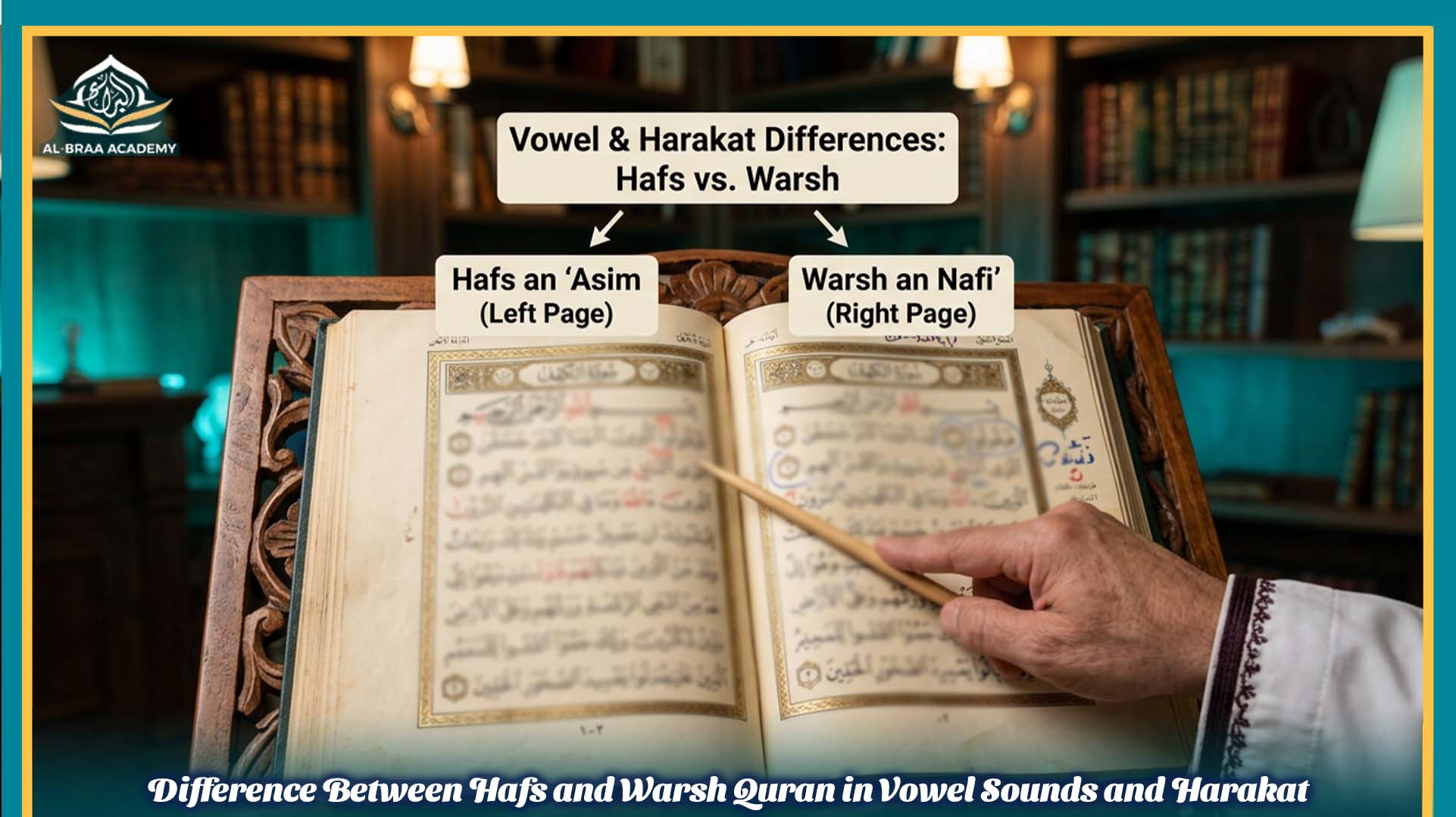
The Difference Between Hafs and Warsh Quran also appears in some vowel movements, which scholars call Harakat.
These differences affect how certain Arabic words sound during recitation. However, they do not change the main meaning of the Quranic message.
The Arabic language has many linguistic features, and Quranic readings preserve these features through authentic chains of transmission.
One famous example appears in Surah Al-Fatihah.
Malik and Maalik in Surah Al-Fatihah
Muslims may hear two authentic readings:
مَلِكِ يَوْمِ الدِّينِ
and
مَالِكِ يَوْمِ الدِّينِ
In Hafs, many readers pronounce the word as:
Malik
Meaning:
King of the Day of Judgment.
In Warsh, many readers pronounce the word as:
Maalik
Meaning:
Owner or Master of the Day of Judgment.
Both meanings are correct because Allah is the King and Owner of the Day of Judgment.
Therefore, this example shows how different authentic readings can add depth and beauty without creating contradiction.
Difference Between Hafs and Warsh Quran in Hamzah Rules
Another area where students notice the Difference Between Hafs and Warsh Quran involves the pronunciation of Hamzah.
Hamzah is an important Arabic letter that requires accurate pronunciation. However, Hafs and Warsh apply different approaches in some situations.
Warsh includes special rules related to:
- Easing the Hamzah sound.
- Combining certain Hamzah positions.
- Moving vowel sounds in specific cases.
- Applying unique pronunciation methods.
On the other hand, Hafs usually keeps the Hamzah pronunciation clearer in many words.
Because these rules require detailed listening, students should learn them from a qualified Quran teacher rather than depending only on written explanations.
Moreover, practical training helps learners develop accurate pronunciation and avoid mixing different recitation styles.
Difference Between Hafs and Warsh Quran in Word Pronunciation
Some Quranic words show another aspect of the Difference Between Hafs and Warsh Quran through different pronunciation patterns.
These variations may include:
- Different vowel sounds.
- Different verb forms.
- Different grammatical endings.
- Different pronunciation of certain letters.
However, these differences come from authentic Quranic transmission. They do not represent errors or changes in the Quran.
For example, Quran scholars studied every letter and movement carefully to preserve each reading exactly as earlier generations transmitted it.
Furthermore, these variations demonstrate the richness of Arabic and the depth of Quranic linguistic sciences.
Difference Between Hafs and Warsh Quran in Waqf and Ibtida Rules
Stopping and starting correctly during Quran recitation represents an important part of Tajweed.
The Arabic terms for these rules are:
- Waqf: stopping during recitation.
- Ibtida: beginning recitation correctly after stopping.
The Difference Between Hafs and Warsh Quran also appears in some stopping methods.
Warsh includes additional rules related to:
- Naql.
- Imalah.
- Taqlil.
These rules influence how some words sound when the reader stops or continues reading.
Meanwhile, Hafs usually feels easier for beginners because many students around the world start with this narration.
Therefore, new learners often prefer Hafs first before studying another Qira’ah.
Difference Between Hafs and Warsh Quran Around the World
The geographical spread of Hafs and Warsh provides another important example of their differences.
Although both narrations share the same Quran, Muslim communities around the world developed different traditions of learning and teaching them.
Countries Where Hafs Is Common
Hafs is the dominant recitation in many regions, including:
- Egypt.
- Saudi Arabia.
- Gulf countries.
- Turkey.
- Pakistan.
- India.
- Indonesia.
- Malaysia.
Furthermore, most printed Quran copies and online Quran applications currently use Hafs narration.
Therefore, many international students encounter Hafs as their first Quran reading style.
Countries Where Warsh Is Common
Warsh remains a major Quran recitation tradition in North and West Africa.It is commonly practiced in:
- Morocco.
- Algeria.
- Tunisia.
- Mauritania.
- Parts of Libya.
- Several West African Muslim communities.
In these areas, many children begin Quran memorization using Warsh because local Quran schools continue this traditional method. As a result, both Hafs and Warsh maintain strong communities of learners and teachers.
Which Recitation Should Beginners Learn First?
Many students ask which recitation they should choose when they begin Quran studies. The answer depends on several factors, including the student’s location, available teachers, learning resources, and personal goals. If you are also searching for the best online Arabic classes, choosing a program that combines Arabic language learning with Quran recitation can make your learning journey much easier.
For most international learners, Hafs provides a practical starting point because:
- Many books use Hafs.
- Most Quran applications follow Hafs.
- Many teachers teach Hafs.
- Beginners hear Hafs frequently.
However, students who live in regions where Warsh is common may benefit from learning Warsh from the beginning.
Most importantly, students should remember that neither recitation is better than the other. Both Hafs and Warsh represent authentic Quranic traditions, and the right choice depends on your learning goals and the guidance of qualified teachers.
The Difference Between Hafs and Warsh

Understanding the Difference Between Hafs and Warsh in the Quran provides valuable knowledge, but practical learning requires continuous training. Many students who enroll in Islamic classes online discover that consistent guidance from experienced teachers helps them develop accurate Quran recitation much faster than studying alone.
A student needs more than reading information about Qira’at. Instead, they need a teacher who listens carefully and corrects mistakes during recitation.
A qualified teacher helps students improve:
- Letter pronunciation.
- Tajweed application.
- Madd timing.
- Quran fluency.
- Correct stopping methods.
Moreover, regular practice allows students to build confidence and develop accurate Quran reading skills.
Many beginners make the mistake of learning only through recordings. Although listening improves familiarity, it cannot replace direct correction from an experienced teacher.
Learning Hafs Recitation Step by Step
Students who choose Hafs usually follow a gradual learning process that begins with learning the Arabic alphabet and basic pronunciation. Then, they study Tajweed rules, practice regularly with a qualified teacher, and steadily improve their Quran recitation skills. Many learners also study Arabic alongside Quran recitation because understanding the language makes memorization and comprehension much easier.
1. Learning Arabic Letters and Pronunciation
The first stage focuses on Arabic letters and their correct sounds. This foundation helps students avoid pronunciation mistakes while building strong reading skills. Students looking for the best academy to learn Arabic often choose an academy that teaches Arabic and Quran together because both subjects support each other.
Students learn:
- Makharij Al-Huroof.
- Similar letter sounds.
- Correct tongue and mouth positions.
- Basic reading skills.
2. Studying Tajweed Rules
After mastering Arabic letters, students begin learning Tajweed. Important rules include:
These rules improve Quran recitation quality and accuracy while helping students read every verse with confidence.
3. Practicing With a Qualified Teacher
Regular practice with a teacher helps students correct mistakes quickly. Furthermore, teachers create lessons based on each student’s level and progress, allowing learners to improve steadily through continuous feedback.
Learning Warsh Recitation Step by Step
Warsh requires the same Quran foundation as Hafs. However, students need additional training because some pronunciation rules differ.
A Warsh student should focus on:
- Warsh-specific Tajweed rules.
- Madd applications.
- Imalah.
- Taqlil.
- Hamzah rules.
- Special pronunciation methods.
Although Warsh may seem difficult at first, consistent practice makes learning easier. Many students enjoy its unique rhythm and traditional North African Quran style, especially when learning under experienced Quran teachers.
Learn the Difference Between Hafs and Warsh Quran with Al Braa Quran Academy
After understanding the Difference Between Hafs and Warsh Quran, many students want to move from theory to practical learning. Reading articles provides useful background knowledge. However, regular practice with qualified teachers builds accurate recitation skills and helps students apply Tajweed rules correctly.
Al Braa Quran Academy offers structured online Quran courses for children, adults, and new Muslims who want to improve their recitation with confidence. The academy also provides programs similar to hifz quran for adults, making it an excellent choice for learners who want to memorize the Quran while mastering Tajweed and authentic recitation.
Teachers begin by evaluating each student’s current level. Then, they create a learning plan that matches the student’s experience, goals, and schedule. As a result, every learner receives personal attention throughout the course.
Students at Al Braa Quran Academy can study:
- Quran reading from the beginning.
- Quran memorization.
- Tajweed rules with practical application.
- Hafs recitation.
- Warsh recitation for advanced learners.
- Daily revision and pronunciation correction.
Moreover, teachers encourage students to practice regularly between lessons because consistent repetition strengthens both pronunciation and memorization. Students who search online for adult quran classes near me often discover that live online classes provide greater flexibility, qualified teachers, and personalized learning regardless of their location.
Why Choose Al Braa Quran Academy to Learn Hafs and Warsh?
Choosing the right Quran teacher plays a major role in learning success. Even motivated students may develop incorrect habits if they study without proper guidance. Therefore, selecting experienced instructors becomes one of the most important decisions for every Quran learner.
Al Braa Quran Academy provides several advantages that help students achieve steady progress.
Qualified Quran Teachers
Experienced teachers explain every Tajweed rule clearly before asking students to apply it during recitation. They also correct mistakes immediately, which helps students avoid repeating incorrect pronunciation.
Personalized Learning Plans
Every student learns differently. Therefore, teachers adjust the lesson pace according to each learner’s ability, previous experience, and personal goals.
Flexible Online Classes
Students can attend lessons from home without changing their daily routine. In addition, flexible scheduling allows learners from different countries and time zones to find suitable class times.
Practical Tajweed Training
Students practice every rule while reading real Quranic verses instead of memorizing theoretical information only. Consequently, they understand how each rule works during actual recitation.
Continuous Progress Evaluation
Teachers monitor student performance after every lesson. Furthermore, they provide clear feedback that helps learners recognize strengths and improve weaker areas.
Because of this organized approach, Al Braa Quran Academy supports students who want to master Quran recitation with confidence and accuracy.
Benefits of Understanding the Difference Between Hafs and Warsh Quran
Learning the Difference Between Hafs and Warsh Quran offers much more than technical knowledge. It also helps students appreciate the remarkable preservation of the Holy Quran and the dedication of Muslim scholars throughout history.
1. Develop Stronger Tajweed Skills
Students who study different authentic recitations become more aware of pronunciation details, articulation points, and Quranic rhythm. As a result, they usually recite with greater confidence and accuracy.
2. Understand Quranic Sciences More Deeply
Learning authentic Qira’at introduces students to one of the most respected branches of Islamic scholarship. Moreover, it explains how scholars preserved every authentic reading through reliable chains of transmission.
3. Appreciate the Richness of the Arabic Language
Different authentic readings reveal the flexibility and beauty of classical Arabic. Therefore, students often gain a deeper appreciation for the language of the Quran.
4. Build Confidence During Quran Recitation
Students who understand why Hafs and Warsh differ no longer feel confused when they hear different reciters. Instead, they recognize these variations as authentic parts of Quranic tradition.
5. Prepare for Advanced Quran Studies
Students who plan to earn an Ijazah or study advanced Qira’at benefit greatly from learning the foundations of Hafs and Warsh first.
Common Mistakes When Studying the Difference Between Hafs and Warsh Quran
Many beginners misunderstand authentic Quran recitations because they lack accurate information. Fortunately, understanding a few common mistakes can help students avoid confusion.
Believing That Hafs and Warsh Are Different Qurans
This misunderstanding appears frequently among beginners. However, Hafs and Warsh represent authentic methods of reciting the same Quran. They never change the beliefs, commands, stories, or message of Islam.
Mixing Rules from Different Recitations
Some students hear different reciters online and unknowingly combine Hafs and Warsh rules during one recitation. Instead, learners should master one narration before studying another.
Depending Only on Audio Recordings
Listening improves familiarity with Quran recitation. Nevertheless, recordings cannot correct pronunciation mistakes. Therefore, students still need qualified teachers who provide direct feedback.
Ignoring Tajweed Foundations
Some learners become interested in different Qira’at before mastering basic Tajweed. However, students should first build a strong foundation because advanced studies become much easier afterward.
Rushing Through the Learning Process
Quran recitation requires patience, consistency, and daily practice. Consequently, students who learn gradually usually achieve better long-term results than those who rush.
Which One Should You Choose?

The best recitation depends on your personal circumstances rather than on superiority. If you live in a country where Hafs dominates, beginning with Hafs usually makes learning easier because teachers, books, and Quran applications commonly use this narration.
On the other hand, students from Morocco, Algeria, Mauritania, or other North and West African countries often choose Warsh because local scholars traditionally teach this narration.
Furthermore, advanced students may eventually study both narrations to expand their knowledge of Quranic sciences.
Whatever choice you make, learning from qualified teachers remains the most important factor for success.
Students who begin their journey with Al Braa Quran Academy receive structured lessons that help them build strong recitation skills while understanding the authentic principles behind every rule.