
Benefits of Daily Duas and Supplications

Benefits of Daily Duas and Supplications: A Simple Guid

The Benefits of daily duas and supplications extend beyond the words recited during a quiet moment of worship. Regular dua can help Muslims maintain remembrance of Allah, express gratitude, seek guidance, and turn to Him during both ease and difficulty. When supplication becomes part of an everyday routine, it can also create meaningful pauses for reflection throughout a busy day. For many Muslims, making dua is not limited to asking for a particular need. It can become a personal form of worship that encourages sincerity, humility, patience, and trust in Allah. Moreover, daily supplication allows a person to connect spiritual intentions with ordinary activities such as waking up, eating, working, studying, traveling, and preparing for sleep. However, building this habit does not require spending hours reciting lengthy supplications. A practical routine can begin with a few authentic duas that fit naturally into the day. Al Braa Quran Academy can also serve as a learning resource for Muslims who want to strengthen their Quranic and Islamic understanding while developing a more consistent relationship with worship. What Are the Benefits of Daily Duas and Supplications? The benefits of daily duas and supplications can be understood through several areas of a believer’s spiritual life. Most importantly, dua creates an opportunity to turn directly to Allah with sincerity and awareness. Rather than treating supplication as something reserved only for difficult situations, Muslims can include it throughout their daily routine. This approach creates regular moments in which a person remembers Allah and reflects on personal needs, blessings, responsibilities, and goals. Some important benefits include: Strengthening remembrance of Allah. Encouraging gratitude for everyday blessings. Developing humility and dependence upon Allah. Providing an opportunity to seek guidance. Supporting patience during difficult circumstances. Helping establish a consistent worship routine. Creating moments of reflection during a busy schedule. Encouraging a person to maintain hope while waiting for an answer. These benefits are not necessarily experienced in the same way by every individual. Nevertheless, consistent dua can become an important part of a balanced Islamic routine when it is practiced sincerely and alongside other acts of worship. Start Your Quran Journey With Al Braa Quran Academy Today If you are ready to begin a meaningful journey with the Holy Quran, Al Braa Quran Academy is here to guide you step by step. Our qualified teachers help you improve your Quran recitation, understand Tajweed rules, and build strong confidence in reading the Quran correctly. Moreover, you can join flexible online classes designed to suit all ages and learning levels. As a result, you can learn at your own pace while maintaining consistency and focus. In addition, our structured lessons ensure steady progress and a clear understanding. Start today and take the first step toward mastering Quran reading with clarity, consistency, and a strong spiritual connection. Spiritual Benefits of Daily Duas and Supplications One of the most important benefits of daily duas and supplications is the opportunity to strengthen one’s awareness of Allah throughout the day. The Quran reminds believers of Allah’s nearness in Surah Al-Baqarah, 2:186, where believers are encouraged to call upon Him. This verse provides an important foundation for understanding dua as a direct act of devotion rather than merely a method of requesting material outcomes. In practical terms, regular supplication gives a Muslim repeated opportunities to pause and remember that success, guidance, forgiveness, and protection ultimately depend upon Allah. Furthermore, dua can encourage a believer to examine intentions before acting. A person who regularly asks Allah for guidance may become more conscious of decisions, relationships, responsibilities, and personal conduct. The habit can therefore become part of a broader spiritual routine that includes: Salah. Quran reading. Dhikr. Repentance. Gratitude. Seeking beneficial knowledge. Helping others. For learners who want to understand Islamic worship more deeply, Al Braa Quran Academy can be incorporated into a broader learning journey focused on Quranic knowledge and consistent religious practice. How Daily Supplication Can Strengthen Remembrance of Allah Another important aspect of the benefits of daily duas and supplications is the way regular remembrance can fit naturally into ordinary activities. A person may make a short dua after waking, before beginning work, when leaving home, before eating, during travel, or before sleeping. Consequently, familiar parts of the day can become reminders to pause and remember Allah. This does not mean every moment needs to be filled with lengthy recitation. Instead, the goal is consistency. A short, sincere supplication practiced regularly may be easier to maintain than a complicated routine that quickly becomes difficult to follow. For example, someone could organize daily supplications around three simple periods: Morning: Begin the day by asking Allah for guidance, protection, and beneficial actions. Daytime: Use suitable moments to express gratitude or seek help with responsibilities. Evening: End the day with remembrance, repentance, gratitude, and prayers for protection. As this pattern becomes familiar, the person may find it easier to associate specific daily activities with remembrance. In turn, worship becomes integrated into the rhythm of everyday life rather than being treated as an isolated activity. Benefits of Daily Duas and Supplications for Gratitude Gratitude is another area in which benefits of daily duas and supplications can become especially meaningful. Modern routines can make people focus heavily on what they still want, what went wrong, or what remains unfinished. A regular habit of dua provides an opportunity to recognize blessings that may otherwise receive little attention. A person can use supplication to thank Allah for health, family, food, shelter, opportunities, knowledge, safety, and countless everyday blessings. Additionally, gratitude does not require perfect circumstances. Someone facing a difficult period can still acknowledge blessings while asking Allah for help with current challenges. A simple gratitude-focused routine might include reflecting on: One blessing received that day. One person for whom you are thankful. One difficulty that taught you something. One opportunity to improve. One request you want to place before Allah. This practice can make dua more personal. Instead of approaching supplication only with requests, a believer can combine praise, gratitude, repentance, and personal needs in a


How to Perform Umrah Step by Step?

How to Perform Umrah Step by Step? A Simple Guide

How to perform Umrah step by step is one of the most important questions for anyone preparing for their first Umrah. The journey is deeply spiritual, but first-time pilgrims may feel uncertain about what to do, when to make the intention, how to perform Tawaf and Sa’i, and what is required to complete the pilgrimage correctly. Umrah is a form of worship that can be performed throughout the year, unlike Hajj, which has specific dates. Although the rituals are relatively short, every stage has its own requirements and practical considerations. Therefore, understanding the process before travelling can help pilgrims feel more confident and focus more fully on worship. For beginners, learning the rituals in the correct order is particularly helpful. Instead of trying to remember everything at once, pilgrims can divide the journey into clear stages: entering Ihram, performing Tawaf, completing Sa’i, and finally shaving or trimming the hair. This guide explains how to perform umrah step by step simply and practically. It also highlights preparation tips, common considerations, health advice, and useful guidance for first-time pilgrims. In addition, Al Braa Quran Academy can help students strengthen their understanding of Islamic worship and learn the religious knowledge they need before beginning their journey. How to Perform Umrah Step by Step? The Four Main Rituals The easiest way to understand how to perform Umrah step by step is to divide the entire process into four primary rituals: Ihram and intention – Entering the sacred state and making the intention for Umrah. Tawaf – Circling the Kaaba seven times. Sa’i – Walking seven times between Safa and Marwah. Halq or Taqsir – Shaving or trimming the hair to complete Umrah. These stages should be performed in their proper sequence. However, preparation begins before reaching the Grand Mosque because the pilgrim must enter Ihram at the appropriate Miqat. For someone performing Umrah for the first time, understanding this basic structure provides a useful mental roadmap. Instead of feeling overwhelmed by the large crowds and unfamiliar surroundings, the pilgrim can concentrate on one stage at a time. Start Your Quran Journey With Al Braa Quran Academy Today If you are ready to begin a meaningful journey with the Holy Quran, Al Braa Quran Academy is here to guide you step by step. Our qualified teachers help you improve your Quran recitation, understand Tajweed rules, and build strong confidence in reading the Quran correctly. Moreover, you can join flexible online classes designed to suit all ages and learning levels. As a result, you can learn at your own pace while maintaining consistency and focus. In addition, our structured lessons ensure steady progress and a clear understanding. Start today and take the first step toward mastering Quran reading with clarity, consistency, and a strong spiritual connection. How to Perform Umrah Step by Step Before Leaving for Makkah? Before learning how to perform Umrah step by step, it is important to prepare both physically and spiritually. Good preparation can make the experience much easier, especially for someone travelling to Makkah for the first time. Start by learning the essential rules of Ihram and the sequence of the rituals. It is also useful to review the supplications you may want to make during the journey. Nevertheless, pilgrims should not feel that they must memorize a long list of prayers before travelling. A simple preparation checklist can include: Learning the basic rules of Ihram. Understanding the location of your Miqat. Preparing suitable clothing. Checking travel and identification documents. Taking necessary medications and personal supplies. Learning the basic movements of Tawaf and Sa’i. Preparing comfortable footwear for walking. Planning sufficient time for rest. Reviewing reliable Islamic guidance before departure. Spiritual preparation matters just as much. Try to approach Umrah with sincerity, patience, humility, and a willingness to avoid unnecessary arguments or distractions. Al Braa Quran Academy can also support learners who want to improve their Quranic knowledge and understand Islamic worship before travelling for Umrah. How to Perform Umrah Step by Step? Entering Ihram The first major stage in how to perform Umrah step by step is entering Ihram. Ihram refers not only to the clothing worn by men but also to the sacred state a pilgrim enters after making the intention for Umrah. Before reaching the Miqat, pilgrims should prepare themselves. Many people take ghusl and make other personal preparations before putting on the Ihram clothing. Preparing for Ihram Before entering Ihram, consider the following: Take a complete bath if possible. Perform wudu. Trim the nails and remove unwanted body hair before entering Ihram if needed. Men should prepare their two pieces of unstitched Ihram clothing. Women should wear modest clothing suitable for worship. Make sure important travel documents are easily accessible. Men traditionally wear two unstitched pieces of cloth. Women do not have a special Ihram uniform and may wear normal modest clothing, while observing the relevant rules of Ihram. The preparation should be completed before crossing the Miqat because the intention and entry into Ihram must occur at the appropriate point. Understanding the Miqat A Miqat is a designated boundary that pilgrims intending to perform Hajj or Umrah should not pass without entering Ihram. The exact Miqat depends on the traveller’s route. Therefore, pilgrims travelling by air should learn in advance which Miqat applies to their journey. Airlines may announce when the aircraft is approaching the Miqat. Even so, it is better to prepare beforehand rather than depend entirely on an announcement. Making the Intention and Reciting Talbiyah After preparing for Ihram, the pilgrim makes the intention for Umrah. A commonly recited wording is: Labbayka Allahumma Umrah This means: “O Allah, here I am to perform Umrah.” The pilgrim then begins reciting the Talbiyah: Labbayka Allahumma labbayk, labbayka la sharika laka labbayk, innal-hamda wan-ni’mata laka wal-mulk, la sharika lak. The Talbiyah expresses the pilgrim’s response to Allah’s call and continues during the journey toward the Sacred Mosque, according to the relevant guidance. Once the pilgrim has entered Ihram, specific restrictions apply. These include avoiding perfume after

Prophet Stories for Kids

Prophet Stories for Kids: Inspiring Lessons and Values for All

Prophet stories for kids offer children more than exciting accounts of extraordinary events. They introduce young learners to the lives of Allah’s prophets and help them understand important values such as faith, patience, honesty, courage, forgiveness, and trust in Allah. When these stories are presented in an age-appropriate way, children can connect Islamic teachings with situations they experience in everyday life. At Al Braa Quran Academy, these meaningful stories can become part of a structured Islamic learning experience that helps children understand prophetic lessons in a clear and engaging way. For parents, choosing meaningful Islamic stories is also an opportunity to make religious education enjoyable rather than overwhelming. A child may remember a lesson about patience more easily when it is connected to the experience of Prophet Ayyub (AS), while the story of Prophet Yusuf (AS) can help explain forgiveness and emotional strength. Through an organized approach such as the one offered by Al Braa Quran Academy, parents can help children explore these values while developing a stronger connection with their Islamic education. Moreover, prophetic stories encourage children to ask questions, reflect on their choices, and understand why good character matters. This makes storytelling a valuable part of Islamic education. With appropriate guidance from Al Braa Quran Academy, children can gradually move beyond simply listening to stories and begin applying their lessons to everyday situations, relationships, and personal behavior. Why Are Prophet Stories for Kids Important? Prophet stories for kids help transform Islamic concepts into memorable narratives. Instead of learning about patience, trust, or honesty only through definitions, children can see how prophets demonstrated these qualities while facing serious challenges. These stories can also strengthen a child’s connection with the Quran. Many prophetic narratives are mentioned in the Quran, so parents and teachers can gradually introduce relevant verses after telling the story. There are several important benefits: Building faith: Children learn about Allah’s power, wisdom, and mercy. Developing character: Stories demonstrate honesty, patience, courage, and compassion. Encouraging reflection: Children can discuss what they would do in similar situations. Strengthening Quranic understanding: Many stories provide context for Quranic passages. Making Islamic learning memorable: Narrative is often easier for young children to remember. Creating positive role models: Prophets provide examples of excellent character and obedience to Allah. Therefore, storytelling should not be treated simply as entertainment. Instead, it can become a carefully planned educational method. Start Your Quran Journey With Al Braa Quran Academy Today If you are ready to begin a meaningful journey with the Holy Quran, Al Braa Quran Academy is here to guide you step by step. Our qualified teachers help you improve your Quran recitation, understand Tajweed rules, and build strong confidence in reading the Quran correctly. Moreover, you can join flexible online classes designed to suit all ages and learning levels. As a result, you can learn at your own pace while maintaining consistency and focus. In addition, our structured lessons ensure steady progress and a clear understanding. Start today and take the first step toward mastering Quran reading with clarity, consistency, and a strong spiritual connection. How Do Prophet Stories for Kids Teach Faith Through Storytelling? Children naturally learn through stories because narratives give information a beginning, a challenge, and a meaningful conclusion. This structure can make difficult Islamic concepts easier to understand. For example, the story of Prophet Ibrahim (AS) presents a powerful lesson about believing in Allah even when others disagree. Prophet Nuh (AS) demonstrates perseverance, while Prophet Musa (AS) shows courage and reliance upon Allah during an apparently impossible situation. At the same time, parents should avoid turning every story into a long lecture. After telling a story, one or two simple questions may be enough: What did the prophet do when he faced difficulty? What can we learn from his response? How could we practice this quality today? This approach allows children to participate actively rather than simply listening. Prophet Adam (AS): A Beginning Filled With Important Lessons Among the most fundamental prophet stories for kids is the story of Prophet Adam (AS), the first human and a prophet of Allah. Allah created Adam (AS), taught him, and placed him and his wife in Paradise. They were given permission to enjoy its blessings while being instructed to avoid a particular tree. After being influenced by Shaytan, they ate from the tree and then recognized their mistake. The important lesson for children is not simply that a mistake occurred. Rather, the story teaches that human beings can make mistakes and that sincere repentance matters. Adam (AS) and his wife turned back to Allah and sought forgiveness. This gives parents an excellent opportunity to teach children that making a mistake does not mean a person has become hopeless or bad. Instead, children can learn to: Admit mistakes honestly. Ask Allah for forgiveness. Avoid repeating harmful behavior. Learn from what happened. Continue trying to become better. This message is especially valuable for young children who are still learning how to handle mistakes. Prophet Nuh (AS): Learning Patience and Perseverance The story of Prophet Nuh (AS) is another powerful example of patience. Allah sent him to call his people toward worshipping Him, yet many people rejected his message. Despite their rejection, Nuh (AS) continued his mission. He did not abandon his responsibility simply because the results were not immediate. Allah eventually commanded him to build the Ark. Nuh (AS) followed the command even though people mocked him. When the flood came, the Ark became a means of safety for those who followed Allah’s guidance. For children, the story can be connected to ordinary situations. A child may struggle to memorize a short surah, learn Arabic letters, improve behavior, or complete a difficult school task. The story of Nuh (AS) teaches that meaningful progress often requires patience. Consequently, parents can use this story to explain that success does not always happen quickly. Doing the right thing consistently is valuable even when other people do not understand it. Prophet Ibrahim (AS): Courage to Stand for the Truth

How to Teach Quran to Children With Learning Difficulties Easily

How to teach quran to children with learning difficulties begins with one important realisation: a child does not have to learn in the same way as everyone else. Some children need more repetition, while others respond better to listening, visual materials, movement, or shorter activities. Therefore, parents should focus on finding a method that matches the child’s individual learning style rather than forcing a standard approach. Learning difficulties can affect Quran reading, memorisation, attention, pronunciation, or the ability to follow several instructions at once. Nevertheless, these challenges do not mean that a child cannot develop Quran skills. With thoughtful teaching, realistic goals, and consistent encouragement, Quran learning can become a positive part of the child’s routine. Most importantly, parents should measure progress according to the child’s own development. A small improvement in reading, attention, confidence, or recitation can represent meaningful progress. The purpose is not to rush through a curriculum but to help the child build skills while developing a comfortable and lasting relationship with the Quran. Best Ways to Teach Quran to Children With Learning Difficulties Before choosing a curriculum, parents need to understand how their child responds to learning. Learning difficulties are not identical, so the same teaching technique will not necessarily work for every learner. Some children may struggle primarily with reading Arabic. Others may find it difficult to maintain attention, process spoken instructions, remember sequences, or cope with changes in routine. Consequently, the first step is observation. Parents can consider questions such as: How long does the child remain engaged with one activity? Does listening work better than reading? Does the child remember information after repeated exposure? Are visual materials helpful? Does movement improve concentration? Which situations create frustration? Does the child prefer predictable routines? Can the child recognize individual Arabic letters? Which Quran activities does the child enjoy most? These questions are not intended to diagnose a condition. Instead, they help parents and teachers identify practical ways to make instruction more accessible. For example, a child with strong auditory memory may respond particularly well to repeated recitation. By contrast, another learner may need large, clear letters and visual prompts before reading becomes comfortable. Start Your Quran Journey With Al Braa Quran Academy Today If you are ready to begin a meaningful journey with the Holy Quran, Al Braa Quran Academy is here to guide you step by step. Our qualified teachers help you improve your Quran recitation, understand Tajweed rules, and build strong confidence in reading the Quran correctly. Moreover, you can join flexible online classes designed to suit all ages and learning levels. As a result, you can learn at your own pace while maintaining consistency and focus. In addition, our structured lessons ensure steady progress and a clear understanding. Start today and take the first step toward mastering Quran reading with clarity, consistency, and a strong spiritual connection. Why does Teaching Quran to Children with Learning Difficulties Require Flexibility? Traditional Quran classes often follow a fixed pattern. The teacher introduces material, the student repeats it, and the class moves forward according to a planned schedule. Although this structure can work for many students, some children need a different pace. A child may have difficulty because: The lesson contains too much material. Instructions are given too quickly. The classroom includes distracting sounds. Reading and memorization are introduced simultaneously. There is little time for repetition. The child is expected to sit still for too long. Mistakes are corrected without enough encouragement. The teacher cannot adjust the lesson immediately. As a result, parents might conclude that their child lacks motivation. However, the real problem may be the teaching environment. Instead of asking why the child cannot follow the lesson, consider what could make the lesson easier. A shorter activity, clearer instruction, or a different learning aid may completely change the child’s response. Furthermore, flexibility allows the teacher to preserve the educational goal while changing the route used to reach it. How to Teach Quran to Children with Learning Difficulties Through Short Sessions? A long lesson does not automatically produce better learning. For children who have difficulty maintaining attention, shorter periods of focused practice can be much more productive. Rather than expecting continuous concentration, divide the lesson into small stages. A session could include: A friendly greeting. A quick review. One small new skill. Guided practice. A short break if needed. Recitation or reading practice. A positive closing activity. The exact duration should depend on the individual child. For one learner, fifteen minutes may provide excellent concentration. Another child might comfortably manage a longer period. Therefore, parents should observe the child’s behavior instead of choosing a fixed duration simply because it is common in traditional classes. Moreover, stopping an activity before the child becomes completely exhausted can protect the positive feeling surrounding Quran time. With consistent practice, the child may gradually tolerate longer activities. Nevertheless, progress should happen naturally rather than through pressure. How Can Visual Learning Improve Quran Lessons? Visual support can make Quran instruction easier for children who struggle with lengthy verbal explanations.A teacher can display one Arabic letter at a time, highlight a specific word, use simple cards, or provide a visual schedule showing what will happen next. These tools reduce the amount of information the child must remember at once. For example, a lesson could follow this visual sequence: Listen → Repeat → Read → Practice → Review The child does not need to guess what comes next. Instead, the visual structure provides a clear path through the lesson. Simple highlighting may also help children focus on specific letters or reading patterns. However, visual materials should remain organized. Too many colors, pictures, or cards can become distracting rather than helpful. The best visual support is usually simple, predictable, and directly connected to the learning objective. Therefore, when parents consider how to teach quran to children with learning difficulties, visual instruction should be considered alongside verbal explanation rather than treated as an optional decoration. How to Teach Quran to Children with Learning Difficulties

Tips to Memorize Quran Faster

Tips to Memorize Quran Faster: Simple and Effective Methods

Tips to memorize quran faster can make the memorization journey more organized, especially when you combine a realistic routine with focused repetition and regular revision. Many learners begin Hifz with enthusiasm but struggle when the amount of new material increases. The solution is not simply to memorize more verses each day. Instead, effective Quran memorization requires a balance between speed, accuracy, understanding, and retention. A practical approach starts with knowing your current level, choosing a manageable daily target, and protecting enough time for Muraja’ah. In addition, your environment can make a major difference. A quiet place, one Mushaf, clear pronunciation, and consistent practice help reduce distractions and make recall easier. Therefore, the goal should be steady progress rather than trying to finish large portions in a short period. For learners who want structured support, Al Braa Quran Academy can be part of a focused Hifz routine by helping students follow a clear learning process. Whether you are a beginner, a busy adult, or a parent supporting a child, the right system can make memorization more manageable. Tips to Memorize Quran Faster With a Clear Plan One of the most important tips to memorize quran faster is to stop treating memorization as an activity that depends on motivation alone. Motivation can help you begin, but a repeatable system helps you continue. When students study whenever they have free time, their progress often becomes inconsistent. Some days may be productive, while other days pass without meaningful revision. A clear plan removes this uncertainty. You know what to memorize, when to review it, and how to measure your progress. As a result, every study session has a specific purpose. Your plan should include: A fixed memorization period. A realistic number of verses or lines. Daily revision of previous material. Weekly review of older portions. Time for correcting pronunciation and Tajweed. A simple method for recording progress. Most importantly, avoid setting a target that is too ambitious. Memorizing five pages in one day may appear impressive, but forgetting them a week later defeats the purpose. A smaller amount that remains strong is usually more valuable than a large amount that quickly disappears. Start Your Quran Journey With Al Braa Quran Academy Today If you are ready to begin a meaningful journey with the Holy Quran, Al Braa Quran Academy is here to guide you step by step. Our qualified teachers help you improve your Quran recitation, understand Tajweed rules, and build strong confidence in reading the Quran correctly. Moreover, you can join flexible online classes designed to suit all ages and learning levels. As a result, you can learn at your own pace while maintaining consistency and focus. In addition, our structured lessons ensure steady progress and a clear understanding. Start today and take the first step toward mastering Quran reading with clarity, consistency, and a strong spiritual connection. Tips to Memorize Quran Faster by Choosing the Right Time Your mental energy changes throughout the day. Consequently, the same memorization task can feel easy in the morning and exhausting late at night. Finding your strongest period can therefore improve both concentration and recall. For many learners, the early morning offers a calm environment with fewer interruptions. However, that does not mean everyone must memorize after Fajr. Students with work, school, or family responsibilities may perform better during another quiet period. Try different times for several days and observe when you can: Concentrate without checking your phone. Read without frequently losing your place. Repeat verses without feeling mentally exhausted. Recall the passage after closing the Mushaf. Once you identify your strongest period, protect it. Even a 30-minute focused session can become productive when repeated consistently. Moreover, keep your routine simple. Before starting, prepare your Mushaf, remove distractions, and decide exactly which portion you will study. This reduces the time lost between deciding to memorize and actually beginning. Tips to Memorize Quran Faster With a Small Daily Target Another useful approach is to make the daily target small enough to complete even on a difficult day. The amount can depend on your age, reading ability, schedule, and previous Hifz experience. For example, a learner might begin with: 3–5 lines per day. Half a page per day. One page when the learner has enough time. A smaller target on busy days followed by additional revision. The key is consistency. A daily target should challenge you without creating unnecessary pressure. If you finish early, use the extra time for revision rather than automatically adding another large portion. This strategy protects your previous memorization while allowing you to increase your pace gradually. At Al Braa Quran Academy, a learner can build a routine around personal ability instead of comparing progress with other students. That individual approach is especially helpful because two learners may require very different amounts of repetition before a passage becomes stable. Tips to Memorize Quran Faster by Breaking Pages Into Sections Large passages can feel difficult when you attempt to memorize everything at once. Therefore, one of the practical tips to memorize quran faster is to divide the page into smaller sections. Start with two or three lines. Read the section carefully several times while looking at the Mushaf. Then close the Mushaf and recite what you remember. If you make a mistake, look again and repeat the difficult portion. Once the first section becomes stable, move to the next one. Afterward, connect both sections and recite them together. You can organize the process like this: Step 1: Read the first few lines carefully. Step 2: Repeat them aloud. Step 3: Recite without looking. Step 4: Correct mistakes immediately. Step 5: Add the next section. Step 6: Connect all sections at the end. This method prevents the memory from becoming overloaded. More importantly, it creates clear mental boundaries between sections, which can make recall easier. Tips to Memorize Quran Faster Through Purposeful Repetition Repetition is essential for Hifz, but simply reading the same verse many times does not guarantee strong memorization. The quality of repetition

Best Quran Reciters to Listen to Online

Best Quran Reciters to Listen to Online Today

The best Quran reciters to listen to online are those who combine beautiful voices, accurate Tajweed, deep understanding of Quranic meanings, and a recitation style that touches the heart. For many Muslims around the world, listening to the Quran online has become an essential part of daily worship, learning, and spiritual connection. With the growth of digital platforms, Muslims can now access thousands of Quran recitations anytime and anywhere. However, choosing the right reciter can make a significant difference, especially for beginners, children, and those who want to improve their own Quran recitation. A skilled Qari not only has a beautiful voice but also demonstrates correct pronunciation, proper pauses, and a strong understanding of Quranic rules. This complete guide explores the most influential Quran reciters, explains what makes their recitations special, and helps you choose the right voices according to your personal goals. Whether you want to memorize Quran, improve Tajweed, or simply enjoy peaceful recitation, discovering the best Quran reciters to listen to online can transform your daily Quran experience. Why Choosing the Best Quran Reciters to Listen to Online Matters? Listening to the Quran is more than hearing beautiful sounds. It is an opportunity to connect with the words of Allah, reflect on meanings, and develop a stronger relationship with the Holy Quran. A great Quran reciter helps listeners understand the rhythm and structure of Quranic verses. Moreover, listening regularly can improve pronunciation and train the ear to recognize correct Tajweed rules. For students who are learning Quran, choosing the right reciter is especially important. A slow and clear recitation can make memorization easier, while an emotional and expressive style can help develop love and appreciation for Quranic verses. Therefore, selecting from the best Quran reciters to listen to online depends on your personal purpose. Some people prefer slow recitations for learning, while others enjoy powerful voices for reflection and spiritual peace. Start Your Quran Journey With Al Braa Quran Academy Today If you are ready to begin a meaningful journey with the Holy Quran, Al Braa Quran Academy is here to guide you step by step. Our qualified teachers help you improve your Quran recitation, understand Tajweed rules, and build strong confidence in reading the Quran correctly. Moreover, you can join flexible online classes designed to suit all ages and learning levels. As a result, you can learn at your own pace while maintaining consistency and focus. In addition, our structured lessons ensure steady progress and a clear understanding. Start today and take the first step toward mastering Quran reading with clarity, consistency, and a strong spiritual connection. What Makes a Quran Reciter Special? A respected Qari possesses several qualities that distinguish their recitation from ordinary reading. Although every believer can recite the Quran, professional reciters spend years mastering pronunciation, melody, and Tajweed. 1. Strong Tajweed Knowledge The first quality of an excellent Quran reciter is mastery of Tajweed. Tajweed ensures that every Arabic letter is pronounced correctly and that every rule is applied properly. A reciter with strong Tajweed protects the original pronunciation of Quranic words. Consequently, listeners who want to improve their own reading can benefit greatly from following such recitations. 2. Beautiful and Natural Voice A beautiful voice attracts listeners and creates a peaceful atmosphere. However, voice alone is not enough. The best reciters combine vocal beauty with correct Quranic knowledge. For this reason, many people searching for the best Quran reciters to listen to online focus on reciters who balance emotion, accuracy, and clarity. 3. Understanding of Quranic Meanings A great reciter understands the meanings behind the verses. This knowledge influences their pauses, tone, and emotional expression. As a result, listeners can feel the message of the Quran more deeply. A verse about mercy, warning, gratitude, or hope should be recited in a way that reflects its meaning. Best Quran Reciters to Listen to Online for Beginners Beginners often need reciters who provide clear pronunciation and moderate speed. Fast recitation may be difficult for new learners because they need enough time to recognize letters and Tajweed rules. Sheikh Mahmoud Khalil Al-Husary Sheikh Mahmoud Khalil Al-Husary is considered one of the greatest teachers of Quran recitation. His style is known for clarity, accuracy, and careful application of Tajweed. Many Quran students choose his recitation because every letter can be heard clearly. Therefore, his recordings are especially helpful for beginners and those who want to memorize the Quran correctly. His slow Tarteel style allows learners to repeat verses easily and understand proper pronunciation. Sheikh Muhammad Siddiq Al-Minshawi Sheikh Muhammad Siddiq Al-Minshawi is famous for his emotional and spiritual recitation style. His voice carries deep feelings that help listeners reflect on Quranic meanings. Furthermore, his recitations are widely appreciated by people who want a peaceful and heartfelt Quran listening experience. Students who are searching for the best Quran reciters to listen to online often choose Al-Minshawi because his recitation combines beauty, emotion, and accuracy. Sheikh Abdul Basit Abdul Samad Sheikh Abdul Basit Abdul Samad is one of the most recognized Quran reciters worldwide. His powerful voice and unique style made him famous across generations. His recitations are admired because of their strength, exceptional vocal control, and emotional impact. Many Muslims still listen to his recordings regularly because they represent a remarkable period in Quranic recitation history. How Online Quran Listening Improves Your Learning? Online Quran listening has changed how Muslims interact with Quran education. Previously, learners needed physical access to teachers or recordings. Today, anyone can listen to expert reciters from anywhere. However, listening alone is not always enough. A structured learning program with qualified teachers helps students correct mistakes and develop proper skills. This is where Braa Quran Academy supports students by providing Quran learning opportunities that focus on correct recitation, Tajweed improvement, and understanding Quranic principles. Through guidance from experienced instructors, learners can combine listening practice with direct correction. Consequently, they can progress faster and build confidence in their Quran reading. Best Quran Reciters to Listen to Online for Tajweed Practice Tajweed learners

Quran Classes for Toddlers

Quran Classes for Toddlers: A Fun Start to Quran Learning

Quran Classes for Toddlers can introduce young children to the Quran, Arabic, Islamic manners, and a love for learning in a gentle and age-appropriate way. At the toddler stage, children learn differently from older students. They respond better to short activities, repetition, stories, visual materials, encouragement, and friendly interaction than to long explanations or demanding assignments. For parents, choosing an early Quran program involves more than asking how many surahs a child can memorize. The quality of the experience matters just as much. A suitable program should respect the child’s age, attention span, personality, and current abilities. It should also create an environment where mistakes are treated as a normal part of learning. At Al Braa Quran Academy, the learning experience can be structured around these principles. Children from approximately three to six years old can gradually become familiar with Arabic letters, Quranic sounds, short surahs, simple duas, selected stories of the Prophets, Islamic manners, and basic Tajweed skills. The purpose is not to rush young learners through a difficult curriculum. Instead, the focus should be on building a strong and positive foundation that can support their Quran journey as they grow. This guide explains what parents should look for in an early Quran program, how lessons can change according to age, which teaching methods can keep young children engaged, and what families can do at home to make learning easier. Why Quran Classes for Toddlers Matter? The early years provide an excellent opportunity to introduce children to familiar sounds, words, routines, and values. Young learners may not understand the complete meaning of every verse, but regular exposure can help them become comfortable with Quranic recitation and Arabic pronunciation. A child who regularly hears Quran recitation may gradually recognize familiar verses and sounds. Simple duas can also become part of everyday life when parents and teachers introduce them through repetition and practical situations. At the same time, early education should remain free from unnecessary pressure. Toddlers naturally have short attention spans, and their learning abilities can differ greatly. One child may happily repeat a verse several times, while another may respond more positively to pictures, movement, or a short story. For that reason, flexibility is essential. A thoughtful teacher knows when to repeat an activity, when to introduce something different, and when the child needs a short pause. Such an approach helps children see Quran learning as a positive experience instead of an obligation they fear. Familiarity also matters. When children encounter Quranic learning in a warm environment from an early age, they can gradually become more comfortable with recitation and basic Islamic concepts. Later, when they begin more structured reading, memorization, or Tajweed study, that early confidence can provide a useful foundation. Start Your Quran Journey With Al Braa Quran Academy Today If you are ready to begin a meaningful journey with the Holy Quran, Al Braa Quran Academy is here to guide you step by step. Our qualified teachers help you improve your Quran recitation, understand Tajweed rules, and build strong confidence in reading the Quran correctly. Moreover, you can join flexible online classes designed to suit all ages and learning levels. As a result, you can learn at your own pace while maintaining consistency and focus. In addition, our structured lessons ensure steady progress and a clear understanding. Start today and take the first step toward mastering Quran reading with clarity, consistency, and a strong spiritual connection. What Do Children Learn in Quran Classes for Toddlers? A toddler does not need an advanced academic curriculum. Too much information at once can make the learning process confusing and tiring. Instead, the program should concentrate on a limited number of meaningful skills. Depending on age and readiness, children may begin with: Recognizing Arabic letters. Listening to correct Quranic pronunciation. Repeating individual Arabic sounds. Memorizing very short surahs. Learning simple daily duas. Becoming familiar with selected names of Allah. Listening to age-appropriate stories about the Prophets. Practicing basic Islamic manners. Developing familiarity with Quranic vocabulary. Building a regular habit of listening to Quran. Beginning simple pronunciation and Tajweed exercises. The sequence should remain flexible. A three-year-old may spend more time listening and repeating, whereas a five-year-old may be ready for more structured letter recognition and memorization. Rather than expecting every child to follow an identical pace, the teacher can adjust the lesson according to individual progress. This makes the learning experience more comfortable and gives children the opportunity to develop confidence. Quran Classes for Toddlers by Age and Learning Stage Children between three and six are not at the same developmental stage. A successful curriculum should therefore become gradually more advanced as the child develops. Level One: Quran Classes for Toddlers Ages 3–4 Children between three and four are still developing their ability to communicate, concentrate, follow instructions, and control their movements. Lessons at this age should consequently remain simple, short, and interactive. Possible learning goals include: Recognizing Arabic letters. Listening to short Quranic passages. Repeating individual sounds. Memorizing one or two very short surahs gradually. Learning basic duas. Listening to selected stories of the Prophets. Practicing Islamic greetings and simple manners. Participating in visual and movement-based activities. Technical explanations should be limited at this stage. Instead of asking a young child to memorize complicated Tajweed terminology, the teacher can demonstrate the correct sound and allow the child to imitate it. Repetition is particularly useful. A child may need to hear the same letter or verse several times before becoming comfortable with it. That is completely normal. The lesson can also move between different activities. A few minutes of letter recognition might be followed by a short story, then a repetition exercise, and finally a simple review. This variety helps maintain attention without making the child feel that learning is difficult.  Level Two: Quran Classes for Toddlers Ages 4–5 Children around four and five often become more curious and communicative. They may begin asking questions about Allah, the Prophets, Paradise, good behavior, and the world around them. The curriculum

teach Islam to kids

Teach Islam to Kids: Simple Steps for Faith and Values

Teach Islam to kids is one of the greatest responsibilities entrusted to every Muslim parent. Beyond teaching prayers or helping children memorize short surahs, Islamic education is about nurturing faith, building strong character, and creating a lifelong connection with Allah. Children naturally learn through observation, kindness, and meaningful experiences, making the home the first and most influential place for Islamic learning. At Al Braa Quran Academy, we believe that every child deserves an engaging and supportive environment where learning Islam becomes a joyful journey rather than a difficult obligation. Through qualified teachers, interactive lessons, and age-appropriate teaching methods, parents can confidently help their children grow into practicing Muslims with strong values and a sincere love for their faith. Why Parents Should Teach Islam to Kids? Raising righteous children is one of the greatest blessings and responsibilities that Allah has given parents. While schools and Islamic centers play an important role, the foundation of a child’s faith begins at home. Every conversation, action, and daily habit contributes to shaping their understanding of Islam. Allah says in the Quran: “O you who have believed, protect yourselves and your families from a Fire whose fuel is people and stones.” (Surah At-Tahrim 66:6) Furthermore, this verse reminds parents that teaching Islam is more than sharing knowledge. It is a lifelong commitment to guiding children toward worship, good manners, and obedience to Allah. Parents are the first role models their children follow, making their actions even more influential than their words. The Prophet Muhammad ﷺ also emphasized this responsibility by teaching that every guardian is accountable for those under their care. This includes nurturing children spiritually, emotionally, and morally until they become responsible Muslims themselves. Start Your Quran Journey With Al Braa Quran Academy Today If you are ready to begin a meaningful journey with the Holy Quran, Al Braa Quran Academy is here to guide you step by step. Our qualified teachers help you improve your Quran recitation, understand Tajweed rules, and build strong confidence in reading the Quran correctly. Moreover, you can join flexible online classes designed to suit all ages and learning levels. As a result, you can learn at your own pace while maintaining consistency and focus. In addition, our structured lessons ensure steady progress and a clear understanding. Start today and take the first step toward mastering Quran reading with clarity, consistency, and a strong spiritual connection. Lead by Example to Teach Islam to Kids Effectively First of all, children imitate what they see far more than what they hear. A parent who prays consistently, speaks kindly, and demonstrates honesty leaves a lasting impression on their child. Before expecting children to practice Islam, parents should strive to strengthen their own relationship with Allah. Allah reminds believers: “There has certainly been for you in the Messenger of Allah an excellent example.” (Surah Al-Ahzab 33:21) Following the Prophet’s example means showing patience, compassion, forgiveness, and sincerity in everyday life. When children witness these qualities regularly, they begin to associate Islam with peace, love, and good character instead of rules alone. At the same time, it’s equally important to remember that guidance ultimately belongs to Allah. Parents are responsible for making every sincere effort, offering advice with wisdom, and continuously praying for their children’s success. Even small daily acts of encouragement can plant seeds of faith that grow throughout a child’s life. Why Does Early Islamic Education Help Teach Islam to Kids? Early childhood is one of the most influential stages in human development. Between the ages of three and twelve, children naturally develop their beliefs, values, and understanding of right and wrong. This period provides the ideal opportunity to introduce Islamic teachings simply and engagingly. Studies in educational psychology suggest that children who receive consistent moral and spiritual education at an early age often develop:  Stronger ethical decision-making skills. Greater emotional resilience. Higher self-confidence. A stronger sense of identity. Better relationships with family and community. Additionally, for Muslim families living in multicultural societies, early Islamic classes online also help children confidently answer questions about their religion while maintaining pride in their Muslim identity. Instead, the goal is not to overwhelm children with information. Instead, parents should gradually build love for Allah, the Quran, and the Sunnah through meaningful daily experiences. Core Islamic Beliefs to Teach Islam to Kids Parents do not need to be Islamic scholars to teach Islam to kids effectively. The Prophet ﷺ encouraged Muslims to convey even a single verse if they knew it. Simple lessons, repeated consistently, often leave the strongest impact. Young children should become familiar with the foundations of faith, including:  Allah is our Creator and Lord. Prophet Muhammad ﷺ is Allah’s final Messenger. The Quran is our divine guidance. Islam is the perfect way of life. Paradise is the reward for those who obey Allah. For example, teaching these concepts through conversations, stories, and everyday examples helps children understand Islam naturally rather than memorizing facts without meaning. The Prophet ﷺ often asked simple questions to strengthen faith and encourage understanding. Parents can follow this approach by asking age-appropriate questions and celebrating correct answers with encouragement instead of criticism. Teach Islam to Kids with Love, Not Fear One of the biggest mistakes parents sometimes make is presenting religion only through warnings and punishment. While children should learn about accountability, their first experience with Islam should be built on Allah’s mercy, forgiveness, and endless blessings. Children should associate Islam with:  Love for Allah. Gratitude for blessings. Respect for others. Family unity. Kindness and generosity. Inner peace. As a result, daily Islamic practices become much easier when children understand their purpose. Explaining why Muslims pray, fast, make dua, or read the Quran creates genuine motivation instead of forced obedience. At Al Braa Quran Academy, lessons are designed to inspire curiosity and build positive emotional connections with Islamic learning, helping children enjoy every step of their educational journey. Teach Islam to Kids with Love, Not Fear While many parents hope their children will memorize the Quran, master Tajweed, or

What Is Islamic Fiqh?

What Is Islamic Fiqh? A Complete Beginner’s Guide

What is Islamic Fiqh? is one of the most common questions asked by Muslims, new converts, and anyone interested in learning how Islamic law guides everyday life. Although many people hear the word Fiqh, they often confuse it with Sharia. However, the two concepts are closely connected but not identical. Fiqh represents the human understanding and practical application of Islamic teachings derived from authentic sources. As a result, it helps Muslims worship correctly, conduct business ethically, maintain family relationships, and address modern-day issues according to Islamic principles. Understanding what Islamic Fiqh is gives Muslims confidence in practicing their religion correctly while appreciating the wisdom behind Islamic rulings. Moreover, whether you are beginning your Islamic studies or looking to deepen your knowledge, learning Fiqh is an essential step. At Al Braa Quran Academy, students learn Islamic Fiqh alongside Quran recitation, Tajweed, and authentic Islamic knowledge through structured lessons taught by qualified teachers. Consequently, this balanced approach helps learners understand both the evidence behind Islamic rulings and their practical application in daily life. Guide for Islamic Fiqh Islamic Fiqh is the science of understanding and interpreting Islamic law through detailed study of the Quran and the authentic Sunnah of Prophet Muhammad ﷺ. Rather than creating new religious laws, Fiqh explains how divine guidance should be understood and applied in different situations. Therefore, it provides Muslims with practical solutions that remain firmly rooted in authentic Islamic teachings. Simply put, Fiqh provides practical answers to everyday questions such as:  How should Muslims perform Salah correctly?  What are the rulings of fasting during Ramadan?  How is Zakat calculated?  What makes a business transaction halal?  What are the Islamic guidelines for marriage and family life?  How should inheritance be divided? Because new situations continue to arise throughout history, scholars study Islamic sources carefully to provide rulings that remain faithful to the teachings of Islam while addressing contemporary issues. Start Your Quran Journey With Al Braa Quran Academy Today If you are ready to begin a meaningful journey with the Holy Quran, Al Braa Quran Academy is here to guide you step by step. Our qualified teachers help you improve your Quran recitation, understand Tajweed rules, and build strong confidence in reading the Quran correctly. Moreover, you can join flexible online classes designed to suit all ages and learning levels. As a result, you can learn at your own pace while maintaining consistency and focus. In addition, our structured lessons ensure steady progress and a clear understanding. Start today and take the first step toward mastering Quran reading with clarity, consistency, and a strong spiritual connection. What Does the Word “Fiqh” Mean? The Arabic word Fiqh (فقه) literally means deep understanding, comprehensive knowledge, or profound comprehension. More importantly, unlike general knowledge, Fiqh refers to understanding the wisdom and legal implications behind Islamic teachings. Instead, it focuses on understanding why rulings exist and how scholars derive them from authentic evidence.  Why a ruling exists.  When it applies.  How scholars reached that conclusion.  What evidence supports it. Therefore, Islamic scholars describe Fiqh as the science of understanding Allah’s guidance through detailed study and careful reasoning. What Is the Difference Between Fiqh and Sharia? One of the biggest misunderstandings about what Islamic Fiqh is is assuming that it is the same as Sharia. However, although the two terms are closely related, they have different meanings. In other words, Sharia represents Allah’s perfect guidance, while Fiqh represents the scholarly effort to understand and implement that guidance in practical situations. Therefore, qualified scholars may sometimes differ in secondary legal matters while remaining united upon the same Quran and Sunnah. Why Is Islamic Fiqh Important? Without Islamic Fiqh, many Muslims would struggle to understand how to apply Islamic teachings to real-life situations. Instead, Fiqh provides practical guidance for every stage of life, including worship, family relationships, financial matters, and ethical conduct. Furthermore, studying what Islamic Fiqh is builds confidence and helps Muslims worship Allah with knowledge rather than imitation. Fiqh provides practical guidance for every stage of life, including: Daily worship Family relationships  Financial transactions  Ethical business practices  Community responsibilities Personal conduct  Social justice Instead of leaving people uncertain about religious matters, Fiqh offers structured guidance rooted in authentic Islamic sources. Likewise, for beginners, studying what Islamic Fiqh is builds confidence and helps them worship Allah correctly with understanding rather than imitation. The Main Sources of Islamic Fiqh Islamic jurists derive rulings from carefully established sources. As a result, every ruling remains connected to authentic Islamic teachings. The Quran The Quran is the primary source of Islamic law. Therefore, every discussion in Islamic Fiqh begins with the Quran before scholars examine other evidence. For example, it contains direct guidance on matters such as:  Prayer  Fasting  Charity  Divorce  Marriage  Justice  Inheritance  Financial ethics Every discussion in Islamic Fiqh begins with the Quran. The Sunnah The Sunnah explains how Prophet Muhammad ﷺ practiced and implemented the teachings of the Quran. Consequently, Muslims learn fiqh online the practical application of many Quranic commands through authentic Hadith. Likewise, through authentic Hadith, Muslims learn: The correct method of performing Salah.  Practical rules for fasting.  Business ethics.  Family responsibilities.  Judicial principles. Without the Sunnah, many Quranic commands would lack practical explanation. Ijma When qualified scholars unanimously agree on a ruling based on authentic evidence, this agreement is called Ijma. As a result, it strengthens legal certainty and preserves unity among Muslims. Ijma strengthens legal certainty and preserves unity among Muslims while preventing confusion in important religious matters. Qiyas Not every modern issue is mentioned directly in classical Islamic texts. Therefore, scholars use Qiyas to compare new situations with established rulings that share the same legal reasoning. Through Qiyas, scholars compare new situations with existing rulings that share the same underlying legal reason. Examples include: Modern financial contracts. Medical ethics. Digital commerce. Contemporary business practices. This method allows Islamic law to remain relevant while staying faithful to its original principles. History of Islamic Fiqh To fully understand what Islamic Fiqh is, it is important to explore how Islamic jurisprudence developed

Difference Between Hafs and Warsh Quran

Difference Between Hafs and Warsh Quran Explained Guide

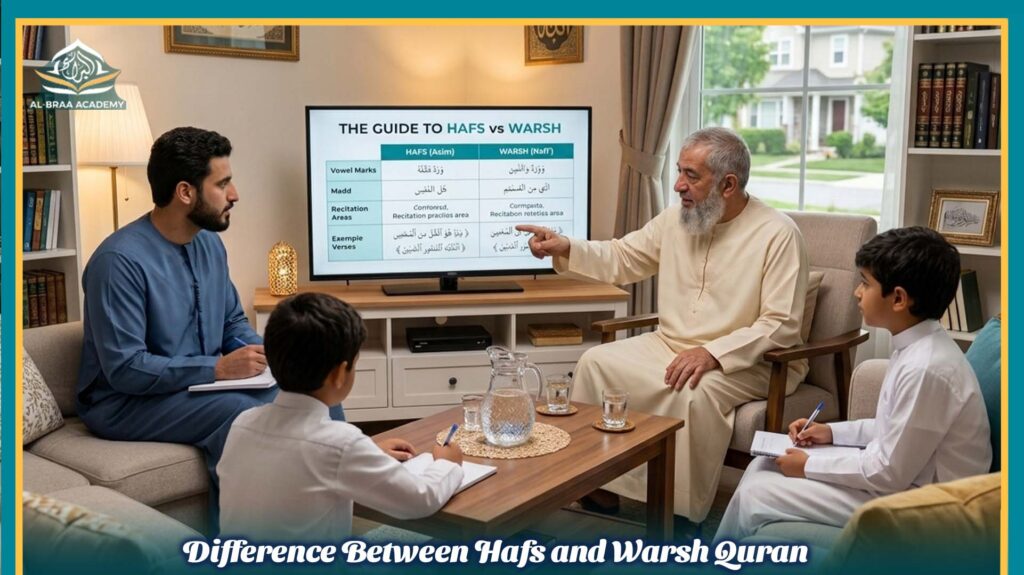
The difference between Hafs and Warsh Quran is a common topic among Quran learners who want to understand why some Muslims recite certain verses with slightly different pronunciations and rhythms. Although these variations may sound different to listeners, they represent authentic methods of Quran recitation that have been preserved carefully throughout Islamic history. Many students who begin learning the Holy Quran ask whether Hafs and Warsh are two different versions of the Quran or whether these recitations have different meanings. However, the truth is that both are authentic narrations of the same Quran that was revealed to Prophet Muhammad ﷺ. The differences between Hafs and Warsh mainly appear in pronunciation, Tajweed rules, vowel sounds, elongation methods, and some linguistic details. Therefore, understanding these differences helps Muslims appreciate the beauty of Quranic sciences and the careful efforts of scholars who transmitted the Quran from one generation to another. Moreover, learning about these recitations gives students a deeper understanding of how the Quran has been preserved with accuracy and precision. Whether a person learns Hafs or Warsh, they are learning the same divine message with the same beliefs, guidance, and teachings. This complete guide explains the history, rules, examples, and learning methods related to Hafs and Warsh while answering the most important questions that Quran students usually ask. What Is the Difference Between Hafs and Warsh Quran Recitations? To understand the Difference Between Hafs and Warsh Quran, we first need to understand the meaning of Quranic recitations and how they were transmitted. Quran recitation, known as Qira’at, refers to the different authentic ways of reading the Quran that were taught through reliable chains of teachers and students. These readings were passed from the Prophet Muhammad ﷺ to his companions and then continued through generations of Quran scholars. The science of Qira’at developed because Arabic has a rich linguistic structure that allows different accepted pronunciations while maintaining the same meaning and message. Among the ten authentic Quran recitations recognized by scholars, Hafs and Warsh are among the most famous and widely practiced. The two main narrations are: Hafs ‘an Asim Warsh ‘an Nafi’ Both narrations follow strict rules of transmission and Tajweed. In addition, both have strong scholarly foundations that confirm their authenticity. They are not separate Qurans. Instead, they are different methods of reciting the same Quranic text. Start Your Quran Journey With Al Braa Quran Academy Today If you are ready to begin a meaningful journey with the Holy Quran, Al Braa Quran Academy is here to guide you step by step. Our qualified teachers help you improve your Quran recitation, understand Tajweed rules, and build strong confidence in reading the Quran correctly. Moreover, you can join flexible online classes designed to suit all ages and learning levels. As a result, you can learn at your own pace while maintaining consistency and focus. In addition, our structured lessons ensure steady progress and a clear understanding. Start today and take the first step toward mastering Quran reading with clarity, consistency, and a strong spiritual connection. Hafs ‘an Asim Recitation Explained Hafs ‘an Asim is the most widespread Quran recitation style in the world today. Millions of Muslims learn and memorize the Quran using this narration because most printed Mushafs and digital Quran applications follow the Hafs reading. The narration was transmitted through: Hafs ibn Sulayman Imam Asim ibn Abi Al-Najud The companions of Prophet Muhammad ﷺ Furthermore, Hafs became especially common in many Muslim countries, including: Egypt Saudi Arabia Turkey Pakistan India Indonesia Malaysia Many international Quran learning communities Because of its global availability, most beginners encounter Hafs when they start reading the Quran. In addition, many online Quran teachers use Hafs as the primary recitation for new students. Hafs is known for its clear pronunciation and straightforward Tajweed application, which makes it suitable for beginners and advanced learners alike. Warsh ‘an Nafi’ Recitation Explained Warsh ‘an Nafi’ is another authentic Quranic narration that has been preserved through a strong chain of Quran scholars. This narration comes from: Warsh Imam Nafi’ of Madinah Earlier Quran teachers who transmitted the recitation Warsh is especially popular in North and West Africa, where many Muslim communities have maintained this tradition for centuries. Countries where Warsh is commonly practiced include: Morocco Algeria Tunisia Mauritania Parts of Libya Several regions in West Africa Furthermore, many Quran students in these areas memorize the entire Quran using Warsh from a young age because local Quran schools continue teaching this narration. Although Warsh may sound different from Hafs, it follows the same Quranic text and represents a respected method of Quran recitation. Why Do Different Quran Recitations Exist in Islam? Many beginners wonder why Muslims have different ways of reciting the Quran. Therefore, understanding the history of Qira’at helps answer this important question. The Prophet Muhammad ﷺ taught the Quran to his companions using different accepted forms of recitation. These forms helped various Arab tribes read and memorize the Quran according to their linguistic abilities. However, these variations never changed the main message of the Quran. Instead, they reflected the flexibility and richness of the Arabic language. Over time, Quran scholars created detailed systems to preserve each authentic reading. Every accepted Qira’ah needed to meet important conditions, including: A reliable chain of transmission from qualified teachers. Agreement with the Arabic language rules. Compatibility with the Uthmani script of the Quran. Therefore, Hafs and Warsh represent examples of the remarkable preservation of Quranic knowledge. Main Difference Between Hafs and Warsh Quran Explained The Difference Between Hafs and Warsh Quran appears in several technical areas related to Quran pronunciation and recitation. These differences include: Tajweed rules. Vowel pronunciation. Madd and elongation. Hamzah treatment. Stopping and starting rules. Some word pronunciation patterns. However, these differences do not affect the message, beliefs, or teachings of the Quran. Instead, they show the depth of Quranic sciences and the careful methods used by scholars to preserve every detail of recitation. Difference Between Hafs and Warsh Quran in Pronunciation Rules One of the most noticeable differences between