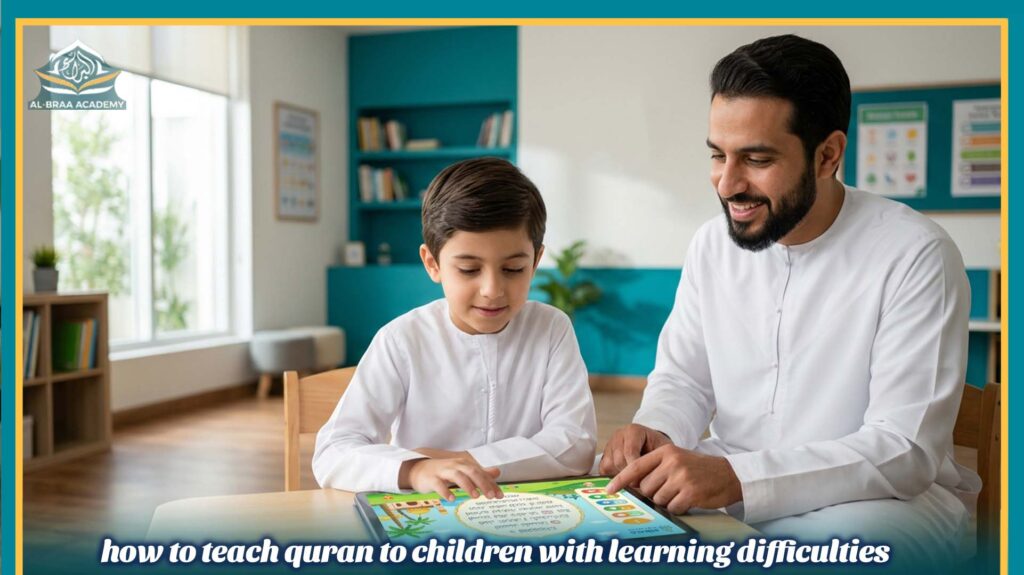
How to Teach Quran to Children With Learning Difficulties Easily
How to teach quran to children with learning difficulties begins with one important realisation: a child does not have to learn in the same way as everyone else. Some children need more repetition, while others respond better to listening, visual materials, movement, or shorter activities. Therefore, parents should focus on finding a method that matches the child’s individual learning style rather than forcing a standard approach. Learning difficulties can affect Quran reading, memorisation, attention, pronunciation, or the ability to follow several instructions at once. Nevertheless, these challenges do not mean that a child cannot develop Quran skills. With thoughtful teaching, realistic goals, and consistent encouragement, Quran learning can become a positive part of the child’s routine. Most importantly, parents should measure progress according to the child’s own development. A small improvement in reading, attention, confidence, or recitation can represent meaningful progress. The purpose is not to rush through a curriculum but to help the child build skills while developing a comfortable and lasting relationship with the Quran. Best Ways to Teach Quran to Children With Learning Difficulties Before choosing a curriculum, parents need to understand how their child responds to learning. Learning difficulties are not identical, so the same teaching technique will not necessarily work for every learner. Some children may struggle primarily with reading Arabic. Others may find it difficult to maintain attention, process spoken instructions, remember sequences, or cope with changes in routine. Consequently, the first step is observation. Parents can consider questions such as: How long does the child remain engaged with one activity? Does listening work better than reading? Does the child remember information after repeated exposure? Are visual materials helpful? Does movement improve concentration? Which situations create frustration? Does the child prefer predictable routines? Can the child recognize individual Arabic letters? Which Quran activities does the child enjoy most? These questions are not intended to diagnose a condition. Instead, they help parents and teachers identify practical ways to make instruction more accessible. For example, a child with strong auditory memory may respond particularly well to repeated recitation. By contrast, another learner may need large, clear letters and visual prompts before reading becomes comfortable. Start Your Quran Journey With Al Braa Quran Academy Today If you are ready to begin a meaningful journey with the Holy Quran, Al Braa Quran Academy is here to guide you step by step. Our qualified teachers help you improve your Quran recitation, understand Tajweed rules, and build strong confidence in reading the Quran correctly. Moreover, you can join flexible online classes designed to suit all ages and learning levels. As a result, you can learn at your own pace while maintaining consistency and focus. In addition, our structured lessons ensure steady progress and a clear understanding. Start today and take the first step toward mastering Quran reading with clarity, consistency, and a strong spiritual connection. Why does Teaching Quran to Children with Learning Difficulties Require Flexibility? Traditional Quran classes often follow a fixed pattern. The teacher introduces material, the student repeats it, and the class moves forward according to a planned schedule. Although this structure can work for many students, some children need a different pace. A child may have difficulty because: The lesson contains too much material. Instructions are given too quickly. The classroom includes distracting sounds. Reading and memorization are introduced simultaneously. There is little time for repetition. The child is expected to sit still for too long. Mistakes are corrected without enough encouragement. The teacher cannot adjust the lesson immediately. As a result, parents might conclude that their child lacks motivation. However, the real problem may be the teaching environment. Instead of asking why the child cannot follow the lesson, consider what could make the lesson easier. A shorter activity, clearer instruction, or a different learning aid may completely change the child’s response. Furthermore, flexibility allows the teacher to preserve the educational goal while changing the route used to reach it. How to Teach Quran to Children with Learning Difficulties Through Short Sessions? A long lesson does not automatically produce better learning. For children who have difficulty maintaining attention, shorter periods of focused practice can be much more productive. Rather than expecting continuous concentration, divide the lesson into small stages. A session could include: A friendly greeting. A quick review. One small new skill. Guided practice. A short break if needed. Recitation or reading practice. A positive closing activity. The exact duration should depend on the individual child. For one learner, fifteen minutes may provide excellent concentration. Another child might comfortably manage a longer period. Therefore, parents should observe the child’s behavior instead of choosing a fixed duration simply because it is common in traditional classes. Moreover, stopping an activity before the child becomes completely exhausted can protect the positive feeling surrounding Quran time. With consistent practice, the child may gradually tolerate longer activities. Nevertheless, progress should happen naturally rather than through pressure. How Can Visual Learning Improve Quran Lessons? Visual support can make Quran instruction easier for children who struggle with lengthy verbal explanations.A teacher can display one Arabic letter at a time, highlight a specific word, use simple cards, or provide a visual schedule showing what will happen next. These tools reduce the amount of information the child must remember at once. For example, a lesson could follow this visual sequence: Listen → Repeat → Read → Practice → Review The child does not need to guess what comes next. Instead, the visual structure provides a clear path through the lesson. Simple highlighting may also help children focus on specific letters or reading patterns. However, visual materials should remain organized. Too many colors, pictures, or cards can become distracting rather than helpful. The best visual support is usually simple, predictable, and directly connected to the learning objective. Therefore, when parents consider how to teach quran to children with learning difficulties, visual instruction should be considered alongside verbal explanation rather than treated as an optional decoration. How to Teach Quran to Children with Learning Difficulties