
Tajweed Rules Of The Quran are essential for every Muslim seeking to recite the Holy Quran accurately and beautifully, and Albraa Academy provides an exceptional platform for mastering these rules.
Understanding and applying Tajweed ensures that each letter is pronounced correctly from its articulation point, preserving the sanctity of Allah’s words and enhancing spiritual connection. Learning these rules improves both fluency and comprehension while avoiding mistakes in recitation.
At Albraa Academy, students receive structured lessons, interactive guidance, and personalized support to effectively grasp basic and advanced Tajweed rules. Students seeking step-by-step guidance can also explore Tajweed Lessons Online for structured and practical learning support. Mastering these rules not only strengthens memorization but also deepens the reverence and beauty of Quranic recitation.
Introduction to Tajweed Rules of the Quran

Our basic tajweed rules can be a good complement for anyone following this path.
Tajweed, an essential concept in Quranic recitation, aims to preserve the correct pronunciation and integrity of the Quran’s words. At Albraa Academy, we emphasize the importance of Tajweed rules for beginners, as they ensure that the recitation of the Quran is free from errors. New learners can also explore Tajweed For Beginners Online to build a strong foundation in correct Quranic pronunciation
By understanding Tajweed, Muslims can enhance their connection with the Quran and ensure their recitations are not only accurate but also melodious.
What Is Tajweed?
Tajweed, from the Arabic word “Tajwīd” (تَجۡوِيد), means “betterment” or “improvement.” In the context of the Quran, Tajweed refers to the art of improving and beautifying the recitation.
By following Tajweed rules, one articulates every letter of the Quran correctly from its articulation point. This process guarantees the preservation of the Quran’s true pronunciation, enhancing the beauty and spiritual experience of reciting the holy text. Many students pair this with our benefits reciting quran to round out their learning.
Why Are Tajweed Rules of the Quran Important?
The Tajweed rules of the Quran are crucial because they ensure that the Quran is recited in its purest and most authentic form. The improper pronunciation of Arabic letters can change the meaning of the words, potentially distorting the intended message of the Quran. Learning Tajweed is essential for every Muslim to protect the integrity of their recitations and maintain the accuracy of the Quranic text. For learners who want to go further, take a look at our 5 pillars faith muslim religion.
Enroll Now for the Best Online Quran Classes at Albraa Academy
Give your child the opportunity to grow spiritually and academically with Albraa Academy’s Best Online Quran Classes for Kids.
Our personalized lessons and expert teachers ensure your child’s learning journey is both engaging and rewarding. Start today and let us guide your child through the teachings of the Quran with ease. Visit Albraa Academy now to get started!

Fundamental Tajweed Rules of the Quran
To understand Tajweed fully, one must familiarize themselves with the basic rules that govern the recitation of the Quran. These rules are divided into categories:
-
The articulation points of each letter.
-
Fixed characteristics that define each letter.
-
The changeable characteristics that may alter the sound of a letter based on surrounding letters.
- Noon Sakinah and Tanween: Core Concepts
Two of the most significant aspects of Tajweed rules are Noon Sakinah and Tanween. Noon Sakinah (ن) occurs when the letter “noon” has a Sukoon (a symbol indicating a pause), while Tanween refers to a diacritical mark that indicates an indefinite noun. Both of these phonetic concepts are fundamental in ensuring clear and precise pronunciation in recitation. - The Role of Izhaar in Tajweed
Izhaar (إظۡهَار) is a key Tajweed rule that means “to make clear.” It is applied when certain letters follow Noon Sakinah or Tanween, and it ensures that the pronunciation is distinct and clear. The letters affected by Izhaar are [ء ه ع ح غ خ]. This rule enhances the clarity of the recitation and adds a melodious touch to the reciter’s voice. - Understanding Idghaam in Tajweed
Idghaam (إدۡغَام) refers to the merging of sounds. This rule occurs when a Noon Sakinah or Tanween is followed by specific letters, leading to the blending of sounds. The sound of Noon Sakinah or Tanween merges with the following letter, making the recitation smoother. There are two main types of Idghaam: with Ghunnah (nasal sound) and without Ghunnah. - Iqlaab: Transforming Sounds in Tajweed
Iqlaab (إقلاب) involves the transformation of the Noon Sakinah or Tanween sound into the sound of Meem (م), particularly when followed by the letter “Ba” (ب). This phonetic shift ensures the integrity of the recitation and maintains its flow. Understanding the concept of Iqlaab is essential for proper Tajweed practice.
Read also: Quran For Kids
The Significance of Ikhfaa in Tajweed
Ikhfaa (إخفاء) refers to the concealment of the Noon Sakinah or Tanween sound when followed by one of 16 specific letters. These letters cause the sound to be partially hidden, contributing to the smoothness of the recitation.
- Noon and Meem Mushaddadah: Emphasizing Pronunciation: The Noon Mushaddadah (النون المشددة) and Meem Mushaddadah (الميم المشددة) refer to the Noon and Meem letters that are marked with a Shaddah diacritical sign. The Shaddah indicates that the letter should be pronounced twice or with emphasis. This rule produces a distinct and harmonious sound in the recitation, adding beauty to the recitation of the Quran.
- Qalqalah: The Echoing Sound in Tajweed: Qalqalah (القلقلة) is a unique feature of Tajweed, occurring when certain letters (ق, ط, ب, ج, د) appear with a Sukoon. These letters produce an echoing or vibrating sound, adding rhythm and musicality to the recitation. Understanding Qalqalah helps reciters achieve a balanced and rhythmic recitation that captures the listener’s attention.
- Madd: The Art of Elongation in Tajweed: Madd (المدّ) refers to the elongation of vowels in the recitation of the Quran. This rule governs the lengthening of vowel sounds, particularly when one of the long vowels (ا, و, ي) is followed by specific letters or diacritical marks. There are different types of Madd, including the original (Al-Madd Al-Asli) and secondary (Al-Madd Al-Farʿiee) elongations, each with its own rules for pronunciation.
- Meem Sakinah and Idghaam Shafawy in Tajweed: Meem Sakinah (م سكون) refers to the letter Meem with a Sukoon. There are specific Tajweed rules that apply when Meem Sakinah is followed by other letters. Idghaam Shafawy is one such rule, where the sound of Meem is merged with the following Meem, producing a complete Ghunnah. This rule is essential for maintaining the integrity and beauty of the Quranic recitation.
The Importance of Tajweed Rules of the Quran in Quranic Recitation
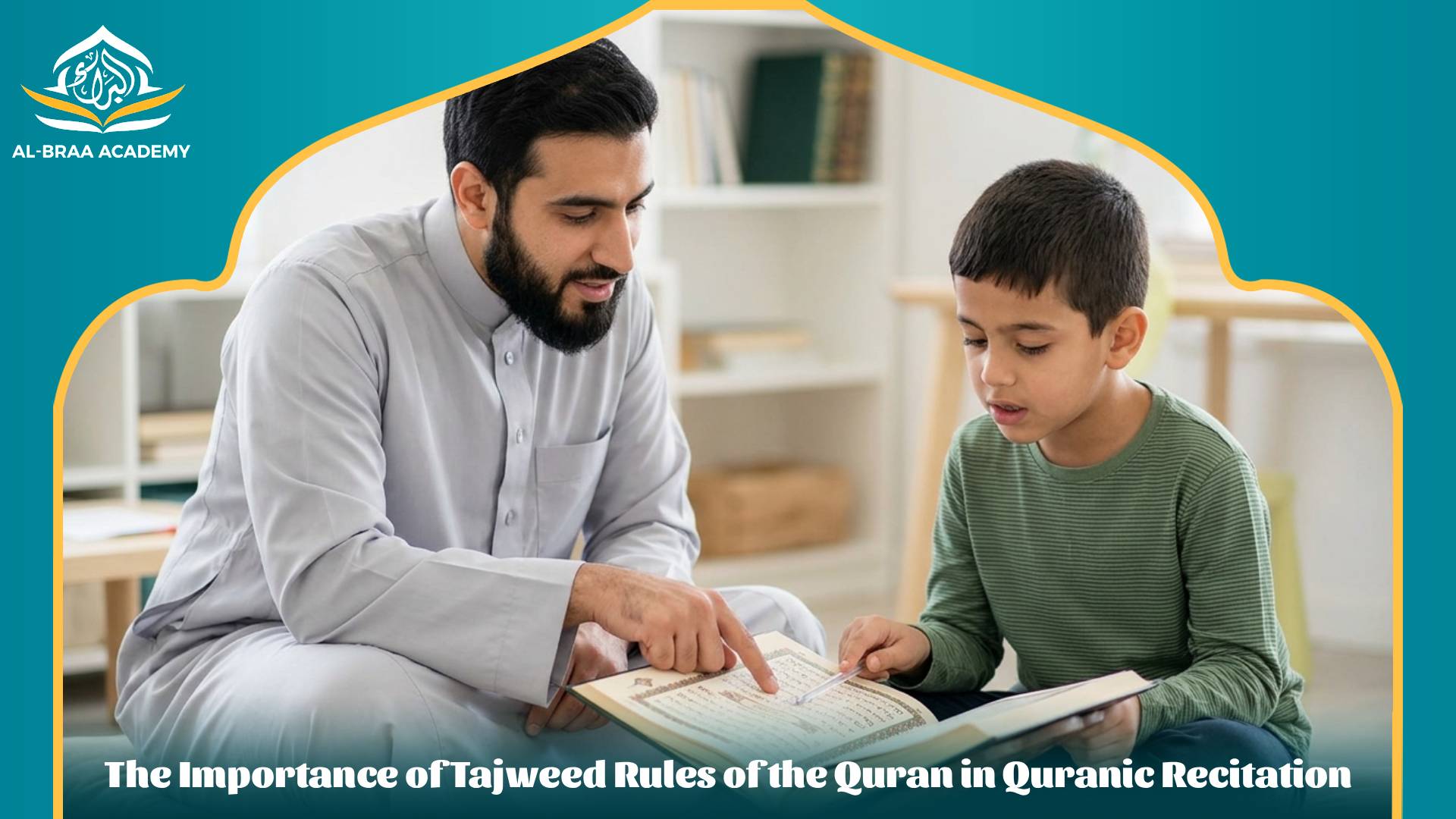
The Tajweed rules of the Quran are integral to ensuring that the recitation of the Quran is done correctly and beautifully. At Albraa Academy, we understand that mastering these rules is not just about avoiding errors; it’s about elevating the spiritual experience of reading the Holy Quran.
By following Tajweed rules, one can articulate every letter of the Quran correctly, giving each letter its due rights. This applies to important rules such as Noon Sakinah, Tanween, Izhaar, and many others. The Tajweed rules are designed to preserve the authenticity of the Quranic recitation and avoid any phonetic errors that may alter the meaning of the words.
Online Tajweed Academy Albraa provides an exceptional learning platform where students can fully understand the Tajweed rules of the Quran, ensuring that they recite the Quran in its most accurate form. Learners looking for flexible study options can also explore Tajweed Quran Online to improve their recitation skills from home. By studying Tajweed rules of the Quran part 1, students develop a deeper connection with the sacred text and can experience the Quran in its purest form.
Noon Sakinah, Tanween, and Their Role in the Quran’s Clarity
At Albraa Academy, we emphasize the importance of understanding Noon Sakinah and Tanween as they are pivotal to Quranic recitation.
Noon Sakinah is a letter that holds a Sukoon, signaling a pause in the pronunciation, and Tanween is used to indicate an indefinite noun. These rules are not just about avoiding mistakes—they are about bringing the Quran to life through clear, melodic pronunciation.
By learning how to apply Noon Sakinah and Tanween correctly, students can ensure that each recitation sounds both beautiful and accurate. These rules are fundamental in providing a steady rhythm to the recitation, allowing the words of the Quran to flow harmoniously.
As part of Tajweed rules of the Quran part 1, these foundational rules serve as the building blocks for more advanced Tajweed studies. At Albraa Academy, we teach our students how to master these rules with patience, practice, and precision, making them an essential part of their Quranic learning journey.
Mastering the Art of Recitation: How Izhaar and Idghaam Enhance Your Quranic Recitation
Izhaar (إظۡهَار) and Idghaam (إدۡغَام) are essential components of Tajweed rules that every reciter must grasp to achieve beautiful and correct recitation of the Quran.
Albraa Academy provides in-depth lessons on how to properly use these two rules to elevate the quality of Quranic recitation. Students who want more guided practice can also explore Tajweed Classes for personalized instruction with qualified teachers. Izhaar, meaning “to make clear,” ensures that the sounds of certain letters following Noon Sakinah or Tanween are distinctly pronounced, adding clarity to the recitation.
On the other hand, Idghaam refers to the merging of sounds, where specific letters blend with the Noon Sakinah or Tanween to produce a smoother and more melodious flow. The correct application of these rules helps create a seamless reading experience, free of errors, while maintaining the Quran’s beauty.
In Tajweed rules of the Quran part 1, both Izhaar and Idghaam are introduced as key elements to refining the recitation, and at Albraa Academy, students are guided through each aspect, ensuring they recite the Quran with precision and beauty.
The Significance of Iqlaab and Ikhfaa in Maintaining the Quran’s Flow
Iqlaab (إقلاب) and Ikhfaa (إخفاء) are two essential rules within Tajweed that maintain the smoothness and clarity of Quranic recitation. Iqlaab involves the transformation of the sound of Noon Sakinah or Tanween into the sound of Meem when followed by the letter “Ba.” This transformation ensures the flow of the recitation is maintained without any disruption.
On the other hand, Ikhfaa refers to the concealment of the sound of Noon Sakinah or Tanween when followed by one of 16 specific letters. Both of these rules contribute significantly to the fluidity and rhythm of the Quranic recitation, preventing any abrupt pauses or changes in tone.
Albraa Academy offers specialized lessons on these concepts as part of Tajweed rules of the Quran. Students are taught to identify when to apply Iqlaab and Ikhfaa, ensuring their recitations are both accurate and melodious. By mastering these rules, learners not only perfect their recitation but also enhance their understanding of the Quran’s linguistic beauty.
The Role of Advanced Tajweed Rules in Quranic Mastery at Albraa Academy

As students progress in their Quranic recitation journey, advanced Tajweed rules become essential to mastering the art of reading the Quran beautifully. At Albraa Academy, we offer a comprehensive curriculum that builds on the foundational Tajweed rules of the Quran to include more complex rules such as the handling of Meem Sakinah, the application of Qalqalah, and various types of Madd.
For example, Qalqalah introduces a unique “echoing” effect, adding rhythm to the recitation, while Madd elongates vowel sounds, enriching the overall auditory experience.
Advanced rules like these are covered in-depth in our Tajweed rules of the Quran book, which is designed to guide students step-by-step through the learning process. At Albraa Academy, we equip our students with the skills and knowledge to master these advanced rules, ensuring their recitation is both accurate and spiritually fulfilling. By continually applying these rules, students not only improve their technical recitation but also deepen their connection to the Quran.
Read more: How to learn Quran at home
Frequently Asked Questions About Tajweed Rules of the Quran
Tajweed Rules of the Quran are often confusing for beginners, so this FAQ from Albraa Academy will help you understand how to start, what to learn first, and how to practice correctly and consistently.
1. What are Tajweed Rules of the Quran?
Tajweed Rules of the Quran are guidelines that teach you how to pronounce each Arabic letter correctly, with proper articulation, lengthening, and pauses, so your recitation matches the way it was revealed.
2. Why should I learn Tajweed Rules of the Quran?
Learning Tajweed Rules of the Quran protects you from major pronunciation mistakes that can change meaning, makes your recitation more beautiful, and helps you connect deeply with the words of Allah.
3. How can Albraa Academy help me learn Tajweed Rules of the Quran?
Albraa Academy offers structured online lessons, qualified teachers, and step-by-step practice so you can learn Tajweed Rules of the Quran from the basics to advanced rules with live guidance and feedback.
4. Can beginners learn Tajweed Rules of the Quran at Albraa Academy?
Yes, Albraa Academy is beginner-friendly. You start with Arabic letters and simple Tajweed Rules of the Quran, then gradually move to Noon Sakinah, Tanween, Madd, and full surah recitation.
5. How long does it take to apply Tajweed Rules of the Quran correctly?
The time varies by student, but with regular practice, following your teacher, and revising daily, most learners start applying basic Tajweed Rules of the Quran correctly within a few months.
6. Do I need to know Arabic to learn Tajweed Rules of the Quran at Albraa Academy?
No, you don’t need fluent Arabic. Albraa Academy explains Tajweed Rules of the Quran in simple language, teaches correct sounds, and helps you recite properly even if your Arabic level is still basic.
In conclusion, learning the Tajweed Rules Of The Quran is crucial for accurate and melodious Quranic recitation, and Online Quran Academy Albraa Academy offers a reliable pathway to achieve mastery.
By following expert guidance and structured lessons, students can correctly apply rules such as Izhaar, Idghaam, Iqlab, Madd, and Qalqalah. Learners based in the United Kingdom can also explore Read Quran Online with Tajweed UK for location-specific online learning opportunities. Mastery of Tajweed ensures clarity, preserves the authenticity of recitation, and enhances memorization skills. Students in the United States can also explore Learn Quran with Tajweed Online USA to strengthen their recitation and memorization journey.
Moreover, practicing these rules nurtures confidence, spiritual connection, and a profound appreciation for the Quran. Readers in Australia can also explore Tajweed Quran Online in Australia for convenient access to expert-led Tajweed instruction. With dedication and support from professional instructors at Albraa Academy, learners can perfect their recitation, making their reading both precise and spiritually fulfilling. If this is an area you’d like to explore in more depth, check out our benefits reading quran tajweed.
Learn also: Learn Quran Basics