How to teach quran to children with learning difficulties begins with one important realisation: a child does not have to learn in the same way as everyone else. Some children need more repetition, while others respond better to listening, visual materials, movement, or shorter activities. Therefore, parents should focus on finding a method that matches the child’s individual learning style rather than forcing a standard approach.
Learning difficulties can affect Quran reading, memorisation, attention, pronunciation, or the ability to follow several instructions at once. Nevertheless, these challenges do not mean that a child cannot develop Quran skills. With thoughtful teaching, realistic goals, and consistent encouragement, Quran learning can become a positive part of the child’s routine.
Most importantly, parents should measure progress according to the child’s own development. A small improvement in reading, attention, confidence, or recitation can represent meaningful progress. The purpose is not to rush through a curriculum but to help the child build skills while developing a comfortable and lasting relationship with the Quran.
Best Ways to Teach Quran to Children With Learning Difficulties
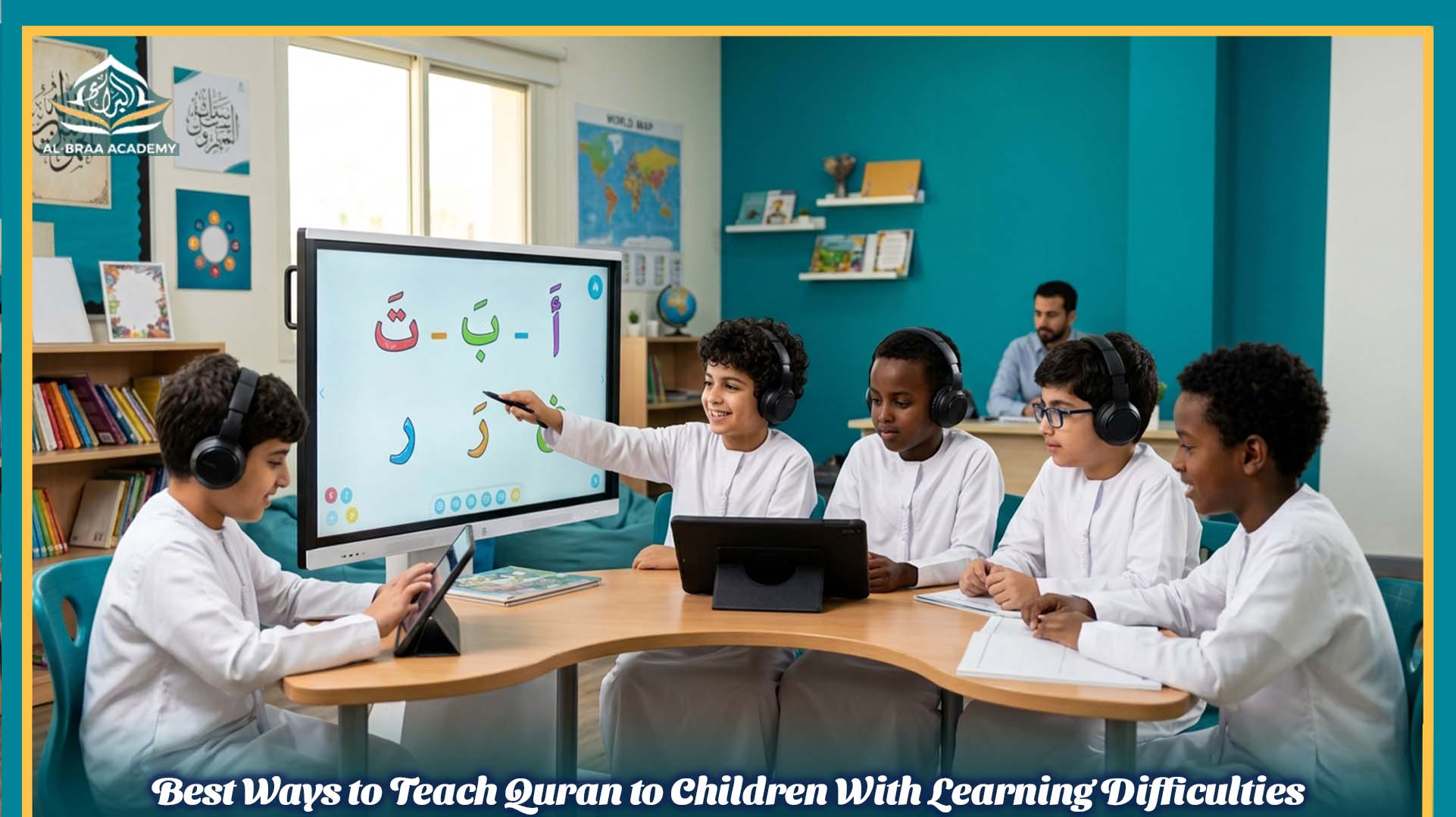
Before choosing a curriculum, parents need to understand how their child responds to learning. Learning difficulties are not identical, so the same teaching technique will not necessarily work for every learner.
Some children may struggle primarily with reading Arabic. Others may find it difficult to maintain attention, process spoken instructions, remember sequences, or cope with changes in routine. Consequently, the first step is observation.
Parents can consider questions such as:
- How long does the child remain engaged with one activity?
- Does listening work better than reading?
- Does the child remember information after repeated exposure?
- Are visual materials helpful?
- Does movement improve concentration?
- Which situations create frustration?
- Does the child prefer predictable routines?
- Can the child recognize individual Arabic letters?
- Which Quran activities does the child enjoy most?
These questions are not intended to diagnose a condition. Instead, they help parents and teachers identify practical ways to make instruction more accessible.
For example, a child with strong auditory memory may respond particularly well to repeated recitation. By contrast, another learner may need large, clear letters and visual prompts before reading becomes comfortable.
Start Your Quran Journey With Al Braa Quran Academy Today
If you are ready to begin a meaningful journey with the Holy Quran, Al Braa Quran Academy is here to guide you step by step. Our qualified teachers help you improve your Quran recitation, understand Tajweed rules, and build strong confidence in reading the Quran correctly.
Moreover, you can join flexible online classes designed to suit all ages and learning levels. As a result, you can learn at your own pace while maintaining consistency and focus. In addition, our structured lessons ensure steady progress and a clear understanding. Start today and take the first step toward mastering Quran reading with clarity, consistency, and a strong spiritual connection.

Why does Teaching Quran to Children with Learning Difficulties Require Flexibility?
Traditional Quran classes often follow a fixed pattern. The teacher introduces material, the student repeats it, and the class moves forward according to a planned schedule. Although this structure can work for many students, some children need a different pace.
A child may have difficulty because:
- The lesson contains too much material.
- Instructions are given too quickly.
- The classroom includes distracting sounds.
- Reading and memorization are introduced simultaneously.
- There is little time for repetition.
- The child is expected to sit still for too long.
- Mistakes are corrected without enough encouragement.
- The teacher cannot adjust the lesson immediately.
As a result, parents might conclude that their child lacks motivation. However, the real problem may be the teaching environment.
Instead of asking why the child cannot follow the lesson, consider what could make the lesson easier. A shorter activity, clearer instruction, or a different learning aid may completely change the child’s response.
Furthermore, flexibility allows the teacher to preserve the educational goal while changing the route used to reach it.
How to Teach Quran to Children with Learning Difficulties Through Short Sessions?
A long lesson does not automatically produce better learning. For children who have difficulty maintaining attention, shorter periods of focused practice can be much more productive.
Rather than expecting continuous concentration, divide the lesson into small stages. A session could include:
- A friendly greeting.
- A quick review.
- One small new skill.
- Guided practice.
- A short break if needed.
- Recitation or reading practice.
- A positive closing activity.
The exact duration should depend on the individual child. For one learner, fifteen minutes may provide excellent concentration. Another child might comfortably manage a longer period. Therefore, parents should observe the child’s behavior instead of choosing a fixed duration simply because it is common in traditional classes.
Moreover, stopping an activity before the child becomes completely exhausted can protect the positive feeling surrounding Quran time. With consistent practice, the child may gradually tolerate longer activities. Nevertheless, progress should happen naturally rather than through pressure.
How Can Visual Learning Improve Quran Lessons?
Visual support can make Quran instruction easier for children who struggle with lengthy verbal explanations.A teacher can display one Arabic letter at a time, highlight a specific word, use simple cards, or provide a visual schedule showing what will happen next. These tools reduce the amount of information the child must remember at once.
For example, a lesson could follow this visual sequence:
Listen → Repeat → Read → Practice → Review
The child does not need to guess what comes next. Instead, the visual structure provides a clear path through the lesson.
Simple highlighting may also help children focus on specific letters or reading patterns. However, visual materials should remain organized. Too many colors, pictures, or cards can become distracting rather than helpful. The best visual support is usually simple, predictable, and directly connected to the learning objective.
Therefore, when parents consider how to teach quran to children with learning difficulties, visual instruction should be considered alongside verbal explanation rather than treated as an optional decoration.
How to Teach Quran to Children with Learning Difficulties Using Repetition?
Repetition is naturally important in Quran education. However, children with learning difficulties may require repetition that is slower, more structured, and more encouraging.
Instead of repeating an entire passage again and again, break it into manageable parts.
A teacher might:
- Recite one short section.
- Allow the child to listen carefully.
- Ask the child to repeat it.
- Correct one important error.
- Repeat the section together.
- Return to it later during the lesson.
This approach prevents the child from feeling overwhelmed.
Additionally, repetition should not always mean doing exactly the same activity. A child might listen first, then repeat, then read the same words, and finally recite them independently.
Such variation provides multiple opportunities to reinforce the same skill.
Most importantly, mistakes should be treated as part of learning. A gentle correction followed by another opportunity is usually more encouraging than repeatedly pointing out what went wrong.
Build a Predictable Quran Routine for Children
Predictability can make Quran learning easier for children who struggle with transitions or unexpected changes.A regular routine tells the child when Quran time will happen, where it will take place, and what the lesson will generally involve. Consequently, the child spends less mental energy wondering what comes next.
A simple routine could look like:
Welcome → Review → New Lesson → Practice → Break → Recitation → Encouragement
The specific content can change while the overall structure remains familiar. Parents can also prepare children before the lesson begins. For instance, a simple reminder that Quran time will start after breakfast can make the transition easier than suddenly interrupting another activity.
At the same time, predictability does not mean rigidity. If a child is unusually tired or overwhelmed, the lesson can be adjusted while maintaining the familiar overall structure.
How to Teach Quran to Children with Learning Difficulties When Attention Is Limited?
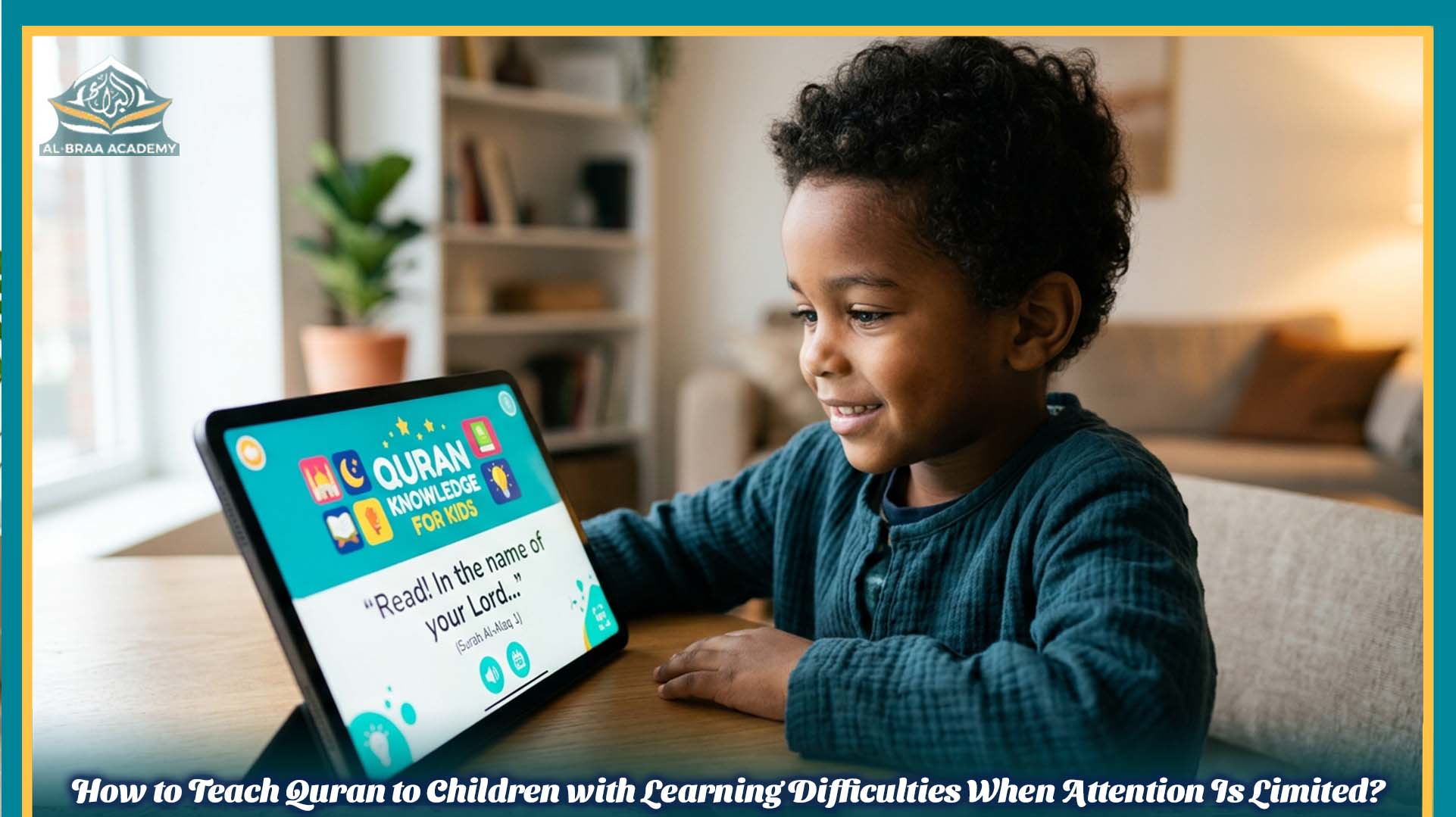
Attention difficulties can make traditional Quran lessons challenging. A child may begin with enthusiasm and then lose focus after only a few minutes. Instead of interpreting this behaviour as laziness, modify the learning experience. Useful strategies include:
- Giving one instruction at a time.
- Breaking reading into small sections.
- Alternating listening and speaking.
- Introducing brief movement breaks.
- Removing unnecessary distractions.
- Reviewing familiar material between new tasks.
- Offering specific encouragement.
- Using clear and predictable transitions.
For example, asking a child to “read this whole page” may feel overwhelming. Asking the child to read two lines first creates a smaller and more manageable target.
Movement can also be useful when used intentionally. Standing briefly, stretching, or changing position may help some children return to the task with better focus.
Therefore, successful attention support is not always about making a child sit completely still. Instead, it involves creating conditions in which the child can participate effectively.
Helping Children Who Find Quran Reading Difficult
Reading Arabic can present a separate challenge from memorization. A child may remember a surah through listening but struggle when looking at the written text. For that reason, reading skills should be developed gradually.A learner may need practice with:
- Arabic letter recognition.
- Letter sounds.
- Connecting letters.
- Short vowels.
- Simple word patterns.
- Reading familiar words.
- Guided Quran reading.
- Gradual independent practice.
Each skill provides a foundation for the next. Parents should also resist comparing the child’s reading speed with other children. Speed is not the only indicator of progress. Accurate recognition, confidence, and willingness to attempt a difficult word are valuable achievements as well.
For instance, recognising several more letters than before may represent an important step even if the child is not yet reading full verses independently.
With this perspective, how to teach quran to children with learning difficulties becomes focused on development rather than comparison.
How to Teach Quran to Children with Learning Difficulties Without Pressure?
Quran learning should challenge children without making them afraid of mistakes. When every lesson feels like an examination, some children begin avoiding participation. Therefore, parents and teachers should create a balance between expectations and emotional comfort. Specific praise can help.
Instead of saying only “Good job,” parents might say:
- “You remembered that letter today.”
- “You repeated the verse without help.”
- “You stayed focused during that activity.”
- “You corrected the word and tried again.”
- “Your recitation was clearer this time.”
Specific feedback shows the child exactly what improved. Furthermore, Quran memorisation should not become a punishment. Children need to understand that Quran time is a meaningful part of their lives rather than something used to control their behaviour.
Challenges will still occur. However, presenting them as achievable steps can encourage persistence without creating unnecessary fear.
Create the Right Environment for Quran Learning at Home
The learning environment can affect concentration more than parents sometimes realise. A useful Quran learning area does not need expensive equipment. Instead, it should minimise distractions and provide the child with a comfortable place to participate.
Consider:
- Keeping background noise low.
- Turning off unnecessary screens.
- Limiting visual distractions.
- Providing comfortable seating.
- Preparing materials before the lesson.
- Using suitable lighting.
- Keeping the learning location consistent.
Timing matters as well. A child who is exhausted after a busy school day may struggle with reading or memorization. Similarly, hunger or overstimulation can make concentration harder.
Therefore, parents should observe when the child is naturally most alert. Once the best time is identified, maintaining a regular schedule can make Quran learning easier to establish as a habit.
Use the Child’s Strengths to Support Quran Learning
A learning difficulty does not define everything a child can do. Some children have strong auditory memories. Others recognise visual patterns quickly. Certain learners respond particularly well to rhythm, repetition, movement, or hands-on activities.
These strengths can become useful pathways into Quran learning. For example, a child who remembers spoken material easily might listen to a short passage several times before connecting it to the written Quran text.
Similarly, a child who learns visually may benefit from seeing the same words repeatedly while hearing them recited. Rather than spending every lesson highlighting weaknesses, use existing strengths to support areas that need more development.
This approach can make teaching Quran to children with learning difficulties more positive because the child begins with abilities they already possess.
How to Teach Quran to Children with Learning Difficulties at Different Stages?
Children do not all reach the same Quran learning milestones at the same age. A younger learner may benefit from listening, recognizing letters, repeating short passages, and becoming familiar with Quran routines.
An older child may be ready for more structured reading, memorization, or Tajweed while still needing individualized support. Consequently, age should be considered alongside ability and readiness.
Early learning may focus on:
- Recognizing Arabic letters.
- Listening to short surahs.
- Repeating simple phrases.
- Developing familiarity with Quran time.
- Building confidence.
As skills develop, children may gradually work toward:
- More independent reading.
- Better pronunciation.
- Basic Tajweed application.
- Memorizing additional surahs.
- Regular revision.
- Greater independence during lessons.
The progression can happen at different speeds. That variation is normal.
Choosing the Right Quran Teacher for a Child With Learning Difficulties
Parents who need outside support should look beyond Quran knowledge alone when choosing a teacher. A suitable teacher should understand that children learn differently and should be willing to adjust the lesson accordingly.
Look for someone who:
- Gives clear instructions.
- Accepts that repetition may be necessary.
- Adjusts the lesson pace.
- Uses encouragement effectively.
- Understands the value of short breaks.
- Communicates with parents.
- Sets realistic goals.
- Measures progress individually.
One important point should remain clear: a Quran teacher provides educational support, not medical or therapeutic treatment.
If a child receives professional educational or developmental support, Quran instruction should work alongside that support rather than replace it.
How Can One-to-One Quran Lessons Help?
Individual lessons give a teacher more freedom to respond to the child’s immediate needs. In a group setting, the teacher usually has to balance the needs of several students. A child who requires additional repetition may therefore feel rushed. Meanwhile, another learner may become bored if the pace is too slow.
One-to-one instruction allows greater flexibility. The teacher can repeat a difficult word, slow down a reading activity, introduce a visual aid, provide additional practice, or move to another activity when necessary.
For parents researching how to teach quran to children with learning difficulties, this individualized structure can be particularly useful when standard group classes have not produced comfortable learning experiences.
Al Braa Quran Academy for Personalized Quran Learning
Al Braa Quran Academy can be considered by parents who want a Quran learning environment that recognizes individual differences.
A personalized approach should begin with the child’s current ability rather than assuming that every learner is ready for the same material. From there, the teacher can establish manageable objectives and adjust the lesson as the child develops.
For example, Al Braa Quran Academy may structure early lessons around basic recognition, listening, or guided recitation when those skills are appropriate for the learner. As confidence increases, the child can gradually move toward more independent reading and memorization.
Parents can also provide useful information before lessons begin. Sharing the child’s preferred learning style, attention patterns, and common sources of frustration gives the teacher a clearer starting point.
Furthermore, Al Braa Quran Academy should be viewed as part of the child’s broader educational support when additional professional services are needed. The strongest Quran learning plan is one that adapts without lowering the child’s potential.
Supporting Quran Learning Between Lessons
Parents play an important role after the formal lesson ends. Nevertheless, home practice does not need to become another lengthy class. A few relaxed minutes can reinforce what the child learned. Parents can:
- Listen to a familiar surah together.
- Review a few Arabic letters.
- Encourage the child to repeat one short passage.
- Read together without demanding perfection.
- Celebrate newly learned material.
- Maintain the regular Quran routine.
Small moments of practice can gradually build familiarity. However, parents should avoid turning every family interaction into a correction session. Constant correction may make the child reluctant to participate.
Instead, create opportunities for successful practice and allow the formal teacher to handle more detailed instruction when appropriate.
How to Measure Quran Progress Beyond Memorization?
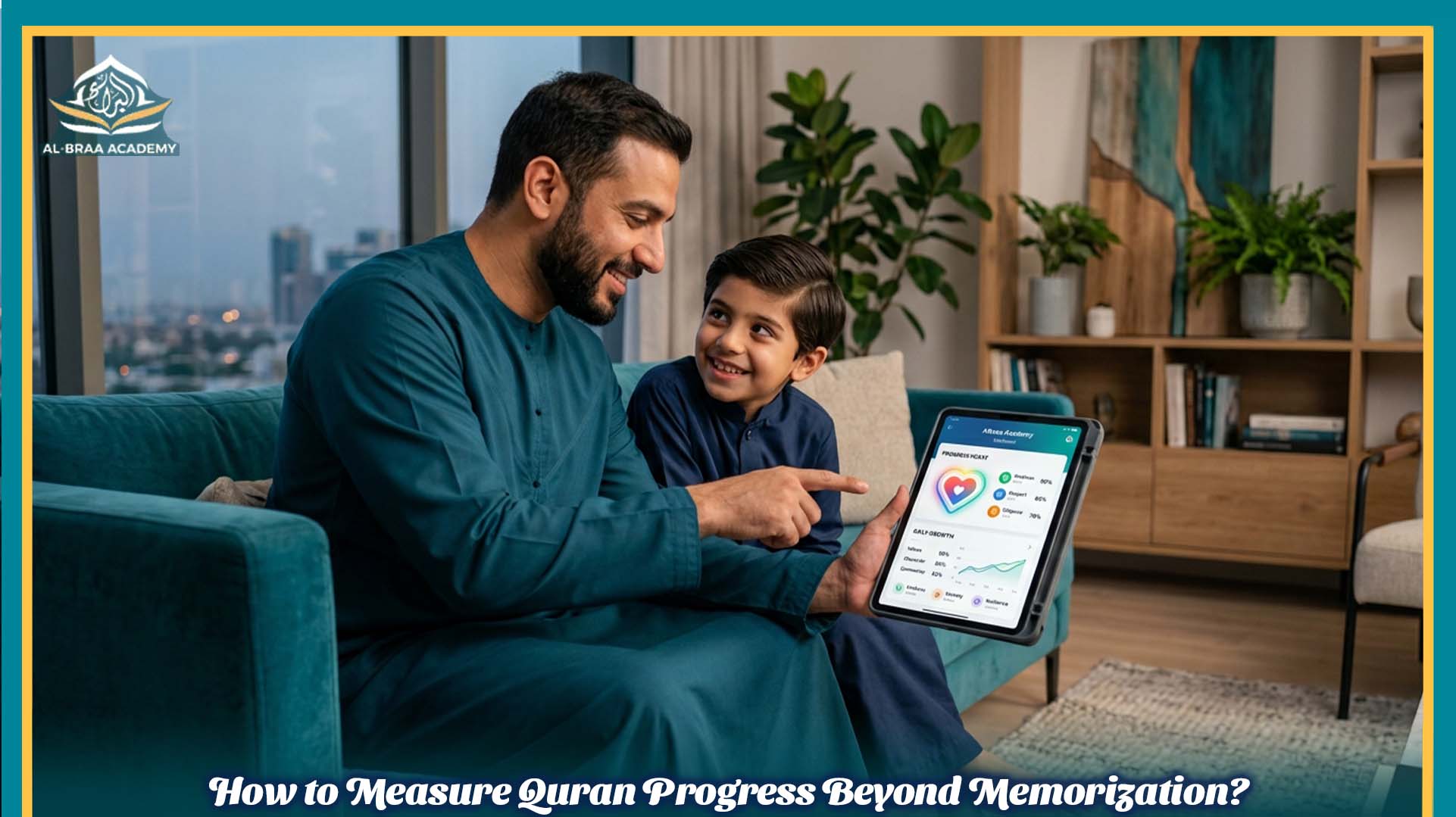
Memorization totals provide only one part of the picture. A child may make substantial progress in other areas before memorizing large amounts of Quran. Parents can therefore track skills such as attention, reading confidence, pronunciation, recognition, and independence.A simple progress record might look like this:
| Skill | Earlier Stage | Current Stage |
|---|---|---|
| Letter recognition | Needed frequent help | Recognizes more letters independently |
| Listening | Very short attention | Longer periods of engagement |
| Recitation | Frequent prompting | More independent |
| Reading | Required close guidance | Reads familiar words with support |
| Confidence | Hesitant | More willing to participate |
This type of record helps families see development that might otherwise go unnoticed. Moreover, it can show which teaching strategies are producing positive results.
If shorter lessons consistently produce better participation, continue using them. If listening helps the child remember material, make auditory practice part of the routine.
What Parents Should Do After a Difficult Quran Lesson?
Some lessons will simply not go well. A child might be tired, frustrated, distracted, or unwilling to participate. Instead of immediately assuming that the teaching method has failed, consider what happened that day. Ask:
- Was the child tired?
- Was the environment distracting?
- Was the task too difficult?
- Did the lesson contain too much new information?
- Was there an unexpected change?
- Did the child need a break?
Once the possible cause is identified, make a small adjustment. Perhaps the next lesson should begin with familiar material. Maybe the teacher should reduce the amount of new content. In another situation, ending early may be more appropriate.
Consequently, flexibility is an important part of how to teach quran to children with learning difficulties. One difficult lesson does not determine the child’s overall ability.
How to Teach Quran to Children with Learning Difficulties While Building Confidence?
Confidence grows when children experience achievable success. A learner who expects to fail may hesitate before attempting a difficult word. On the other hand, a child who knows that mistakes are accepted may be more willing to practice and keep trying.
Parents can encourage confidence by:
- Recognizing effort.
- Celebrating small improvements.
- Avoiding comparisons.
- Offering manageable choices.
- Allowing the child to demonstrate familiar skills.
- Giving specific positive feedback.
For example, allowing the child to choose which familiar surah to review can provide a small sense of control. Likewise, asking the child to demonstrate a letter they already know can create an early success during a challenging lesson. These moments matter because confidence can influence the child’s willingness to continue learning and participate in activities such as online quran memorization classes.
Working With the Child’s Existing Support Team
Some children receive assistance from educators or other professionals. Quran teachers should respect those roles rather than attempting to replace them. Parents can share relevant learning strategies when appropriate, especially when the child follows a consistent learning routine.
For instance, if a child responds well to visual schedules, a Quran teacher may use a similar structure. If the child benefits from one instruction at a time, the teacher can simplify directions. This consistency can make learning more comfortable across different environments, including Online Quran lessons USA.
At Al Braa Quran Academy, parents can communicate useful observations about what helps their child learn. Open communication gives the teacher more information and can support a more individualized Quran experience.
Common Mistakes to Avoid When Teaching Quran
Good intentions do not always produce good learning conditions. Parents may accidentally create pressure when they focus too heavily on speed or comparison.
Avoid:
- Comparing the child with siblings or classmates.
- Expecting rapid memorization.
- Making every session unnecessarily long.
- Introducing too many new skills at once.
- Correcting every minor mistake.
- Ignoring signs of fatigue.
- Changing methods constantly.
- Treating refusal as simple disobedience.
- Measuring success only by the number of memorized verses.
- Assuming one difficult method means the child cannot learn.
Instead, focus on adaptation. If a strategy consistently creates frustration, reconsider the strategy before blaming the learner. This principle is useful not only for Quran education but also when children participate in broader language-learning programs such as an Online Arabic academy for kids.
That mindset is particularly important when exploring how to teach quran to children with learning difficulties because successful instruction depends on responsiveness, patience, and an understanding of the child’s individual needs.
How to Teach Quran to Children with Learning Difficulties With Realistic Goals?
Clear and realistic goals help families maintain progress without creating unnecessary pressure. For a beginner, an appropriate goal may be recognizing several Arabic letters. Another learner may be ready to read a few words with guidance. Someone else may be able to memorize a short surah through listening.
Possible short-term goals include:
- Recognizing new letters.
- Improving pronunciation of selected sounds.
- Reading familiar words.
- Repeating a short verse.
- Reviewing previously learned material.
- Increasing independent participation.
- Becoming more comfortable with Quran lessons.
As these skills improve, goals can become more advanced. Parents may also support these foundations through Online Arabic classes when additional Arabic practice can help the child’s Quran learning.
Realistic expectations do not mean lowering standards. Instead, they create a path that allows the child to reach higher goals gradually.
A child can continue working toward fluent Quran reading, stronger Tajweed, memorization, and greater independence. The important difference is that the journey follows the learner’s development rather than forcing the learner to follow an unsuitable pace.
How Can Al Braa Quran Academy Build an Individual Learning Path?
Families considering Al Braa Quran Academy should look for flexibility rather than a rigid program that expects every student to progress identically.
An individualized learning path begins by identifying the child’s current skills. Next, the teacher can select appropriate activities and establish manageable goals.
For one child, the first stage may focus heavily on listening and letter recognition. Another learner may begin with guided reading. A more advanced student might need help organizing revision and improving recitation accuracy. In some cases, families may also benefit from an Arabic course online to strengthen supporting language skills.
As the learner develops, the balance can change. A strategy that works well at the beginning may need to be adjusted later as the child’s confidence, attention, reading ability, and independence improve.
Al Braa Quran Academy can also provide an opportunity for parents and teachers to communicate about progress. Regular communication helps ensure that expectations remain realistic and that successful strategies are repeated.
Ultimately, Al Braa Quran Academy should support the principle that every child deserves an appropriate path toward Quran learning. With patience, flexibility, and consistent encouragement, parents can help their children develop a positive and lasting relationship with the Quran.
When Should You Change the Quran Teaching Method?
A teaching method may work well initially and become less effective later. Children develop new skills, and their learning needs can change. Therefore, parents should periodically evaluate the experience rather than assuming that the same strategy must continue forever.
A change may be worth considering when:
- The child consistently avoids Quran lessons.
- Progress remains unchanged for a long period.
- The current pace causes repeated frustration.
- The child understands spoken material but struggles with written tasks.
- The lessons no longer match the child’s ability.
- A different learning style produces better engagement.
Changing the method does not necessarily mean that the teacher has failed. Instead, it may indicate that the child has entered a new stage. Good instruction responds to development.
How to Teach Quran to Children with Learning Difficulties for Long-Term Success?
The ultimate objective is not simply to finish a certain number of pages. Parents naturally want their children to read accurately, memorize meaningful portions, and develop strong Quran skills. Those goals are valuable, but long-term success also depends on how the child feels about learning.
A child who associates Quran time with encouragement is more likely to return willingly.
Perhaps the journey begins with listening. Later, the child recognizes letters and reads familiar words. Eventually, independent recitation and memorization become possible.
The pace may be slower than that of another child. Nevertheless, the achievement remains meaningful.
Long-term Quran learning requires patience, consistency, adaptation, and realistic expectations. When children are given room to learn according to their abilities, they can develop both practical skills and a lasting connection with the Quran.
A Daily Quran Learning Plan for Children With Learning Difficulties
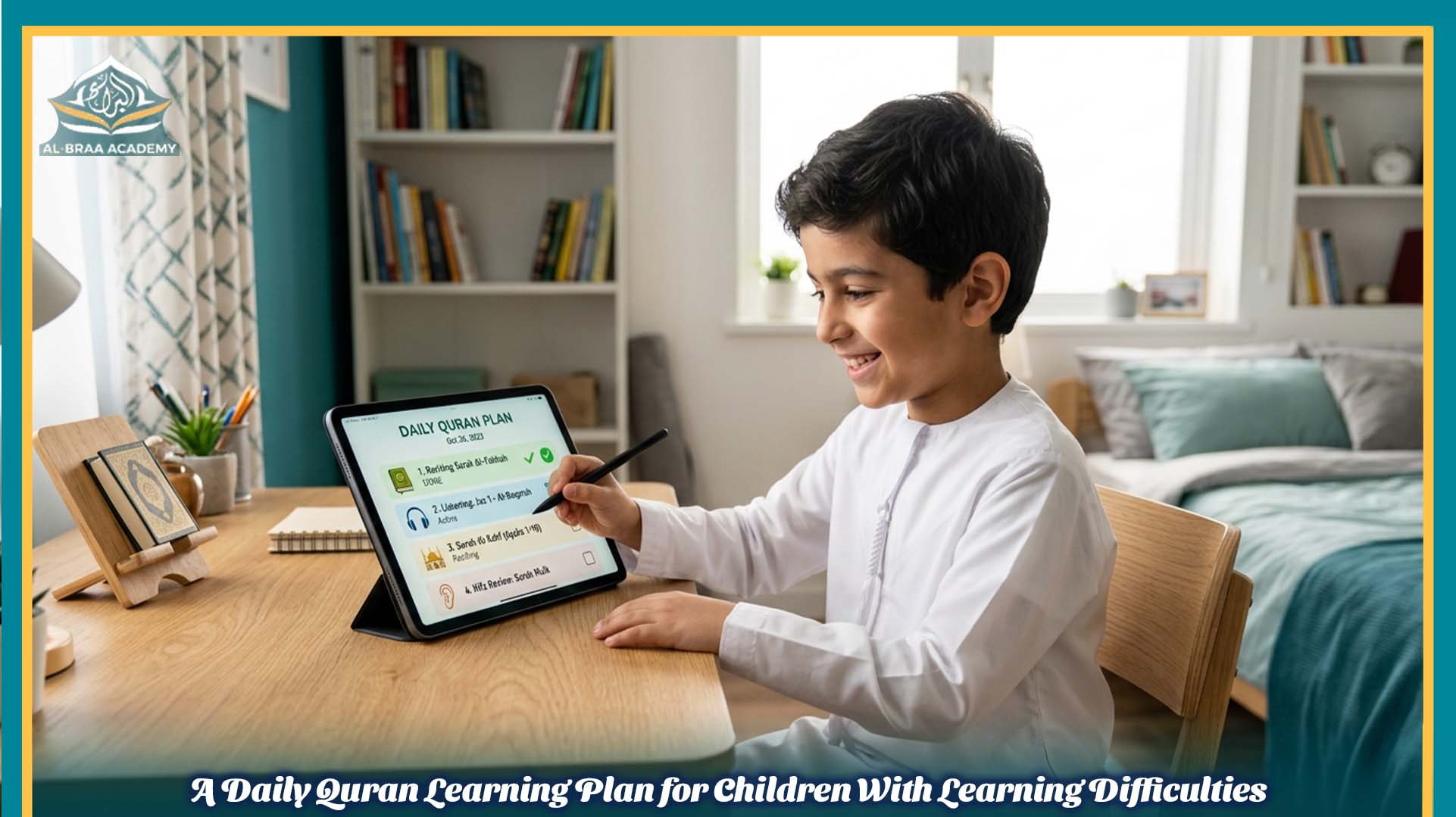
Parents can use this simple framework to make Quran learning easier, calmer, and more consistent. The goal is to create a routine that matches the child’s abilities while allowing enough flexibility for difficult days.
How to Teach Quran to Children With Learning Difficulties With One Clear Goal?
Choose one skill per session, such as reading a letter, practicing a verse, improving pronunciation, or reviewing memorized material. Keeping one main goal helps the child stay focused and makes progress easier to recognize.
How to Teach Quran to Children With Learning Difficulties Through Review?
Start by reviewing familiar material before introducing something new. This builds confidence and gives the child a successful beginning. Even a few minutes of review can help prepare the child for the next activity.
How to Teach Quran to Children With Learning Difficulties Using Simple Instructions?
Give one instruction at a time and allow the child enough time to respond. Break difficult activities into small, clear steps instead of giving several directions at once. As a result, the child can focus on the task without feeling overwhelmed.
How to Teach Quran to Children With Learning Difficulties Using Different Methods?
Use listening, visual support, repetition, reading, or movement based on what helps the child learn best. For example, some children may benefit from hearing a verse several times, while others may need to see the words clearly. Stay flexible and adjust the method when needed.
How to Teach Quran to Children With Learning Difficulties With Short Breaks?
Include a brief break when attention decreases or frustration appears. A few minutes of movement, stretching, or quiet time can help the child refocus. Therefore, breaks should be viewed as part of the learning routine rather than a sign of failure.
How to Teach Quran to Children With Learning Difficulties With a Positive Ending?
End with a familiar verse or activity the child can complete successfully. This gives the lesson a positive ending and helps the child feel that progress is possible, even when part of the session was challenging.
How to Teach Quran to Children With Learning Difficulties by Tracking Progress?
Record one small achievement after each lesson, such as recognizing a letter, repeating a verse, improving pronunciation, or completing a task independently. Over time, these small improvements provide a clearer picture of the child’s progress and help parents decide what to practice next.
FAQ: How to teach quran to children with learning difficulties
Below are some common questions parents may have about choosing the right approach and supporting their child’s Quran learning journey.
What should parents prepare before their child starts Quran lessons?
Parents can prepare by identifying the child’s preferred learning style, typical attention span, previous Quran experience, and any teaching strategies that have worked well in the past. Sharing this information with the teacher can make the first lessons more productive.
How can siblings participate without making the child feel compared?
Siblings can join Quran activities through shared listening or family recitation, but each child’s goals should remain individual. Celebrating everyone’s progress separately helps prevent competition from becoming the focus.
Should Quran lessons be changed during school holidays?
A holiday can be a useful opportunity to adjust the schedule, but completely stopping learning may make returning harder for some children. Maintaining a light and familiar routine can provide continuity while still allowing additional rest.
What should parents ask before enrolling their child in an online Quran program?
Ask how the teacher adapts lessons for different learning needs, how parents receive progress updates, what happens when a child struggles during a session, and whether the program can adjust goals according to the learner’s current abilities.
In conclusion, learning Quran with a child who has learning difficulties may require more flexibility than following a standard curriculum. However, the presence of a learning challenge does not remove the possibility of meaningful Quran education.
The strongest approach starts with the individual child. From there, parents and teachers can adjust lesson length, repetition, visual support, routines, expectations, and goals.
Most importantly, avoid measuring your child’s journey against another child’s progress.
A learner who needs more time is still learning. A child who relies on repeated listening is still developing valuable Quran skills. Someone who progresses slowly can still build a deep and lasting connection with the Quran.
If you are exploring Al Braa Quran Academy, consider whether its approach can accommodate your child’s individual learning needs and current ability.
Ultimately, how to teach quran to children with learning difficulties is not about finding a single perfect technique. It is about creating a learning environment in which the child can understand, practice, make mistakes, improve, and feel encouraged to continue.
With patience and individualized support, Quran learning can become a meaningful and positive part of the child’s life.