Arabic Alphabet for Kids at Al-Braa Academy introduces young learners to the foundations of the Arabic language in a fun and engaging manner. By learning the Arabic letters, children can gradually build skills necessary for reading the Quran and understanding its meanings.
Classes incorporate interactive exercises, visual aids, and guided practice to ensure that kids retain what they learn and enjoy the process. With patient instructors and structured lessons, Arabic Alphabet for Kids at Al-Braa Academy provides a supportive environment that encourages curiosity, strengthens memory, and lays a solid foundation for lifelong Quranic learning.
Introduction to Arabic Alphabet for Kids

Learning the Arabic alphabet is an essential step for children who want to read, write, and understand the Arabic language. At Al-Braa Academy, Arabic Alphabet for Kids courses are designed to make learning fun, interactive, and age-appropriate.Users can also explore Arabic Classes Near Me for more related options.
The Arabic alphabet is a unique writing system called an abjad, which is used to write several languages, including Arabic, Persian, Urdu, Pashto, and Kurdish. For young learners, understanding the basic structure of the alphabet is the first step toward reading the Quran and connecting with their cultural and religious heritage.
The Arabic alphabet is written from right to left, unlike English which is left to right. It has 28 letters when used for the Arabic language. Most letters represent consonant sounds, while vowels are generally omitted in writing. This means children will learn to recognize consonant patterns first, building a strong foundation for reading fluency.
Additionally, the Arabic alphabet is cursive, so letters in a word connect differently depending on their position. Teaching kids how to recognize these forms early helps them develop their reading skills and gain confidence in understanding Arabic texts.
Using modern Arabic Alphabet Learning App for Kids, children can see letters in interactive forms, hear pronunciations, and practice tracing shapes. By combining visual, auditory, and tactile methods, Al-Braa Academy ensures that learners grasp the alphabet quickly and effectively. This structured approach not only improves memorization but also keeps children engaged, making Arabic alphabet learning a fun and rewarding experience.
Read also: Online Quran Academy for kids
Achieve Quran Mastery Easily Through Al-Braa Academy
Unlock your potential in Quran memorisation and recitation with Al-Braa Academy. Our structured courses guide learners through Tajweed, Hifz, and Quran comprehension step by step. Whether you prefer one-on-one sessions or group lessons, our flexible approach ensures you progress confidently.
Join countless students who have benefited from our personalised attention and supportive learning environment. Start your journey now, gain spiritual growth, and achieve Quran mastery with the guidance of Al-Braa Academy.

Consonants, Vowels, and Writing Styles in Arabic Alphabets for Kids
The Arabic alphabet focuses primarily on consonants, which makes it different from alphabets like English. In an abjad, the main letters represent consonant sounds, and vowels are indicated with optional diacritical marks. When teaching Arabic Alphabets for Kids, understanding this structure is crucial because it allows children to identify patterns in words and pronunciation.
Al-Braa Academy’s courses emphasize the consonants first, introducing vowels gradually to build reading accuracy and comprehension.
Arabic is written in a cursive style, meaning that letters within a word are connected. Each letter can look different depending on its placement at the beginning, middle, or end of a word. Teaching children these positional variations early enhances their ability to read and write accurately.
The two primary writing styles that kids encounter are Naskh, which is used in printed books, and Kufic, often used decoratively or in historical texts. Learning these styles broadens children’s familiarity with written Arabic and prepares them for both modern and classical texts.
With the use of Arabic Alphabet Learning App for Kids, young learners can practice letters interactively, tracing their shapes, recognizing sounds, and listening to pronunciations. Combining traditional teaching with digital tools makes the learning process dynamic and engaging.
online Arabic academy Al-Braa ensures that every child develops a strong grasp of both the form and function of letters, setting a solid foundation for reading, writing, and eventually understanding more complex texts such as the Quran.
Read also: Ijazah Course
Learn More: Islamic Studies
History and Global Use of Arabic Alphabets Learning for Kids
The Arabic alphabet has a long and fascinating history, originating from the Nabataean and Aramaic scripts. Over time, it spread throughout the Middle East, North Africa, and parts of Asia, becoming the script for Arabic, Persian, Urdu, Pashto, and several other languages.
For children learning Arabic Alphabets Learning for Kids, knowing the historical context helps them appreciate the alphabet not just as letters, but as part of a rich cultural and linguistic heritage.
The spread of the Arabic alphabet was closely tied to the growth of Islam, as the Quran was revealed in Arabic. Learning these letters allows children to engage with Islamic texts, prayers, and literature from an early age. In many countries, the Arabic script is the official writing system, while in others, it is used alongside local scripts.
Understanding this global distribution reinforces the importance of learning the alphabet as a key skill in connecting with diverse communities.
At Al-Braa Academy, Arabic Alphabet for Kids courses incorporate historical and cultural context to make learning meaningful. Children not only practice letters but also explore their origins, uses, and variations across countries.
This approach encourages deeper engagement, enhances memory retention, and develops a lifelong interest in Arabic language learning. Interactive exercises, tracing, and audio-visual aids make the learning process enjoyable, allowing kids to progress confidently and prepare for advanced reading and writing tasks.
Read also: Online Islamic Academy
Modern Tools for Arabic Alphabet Learning for Kids
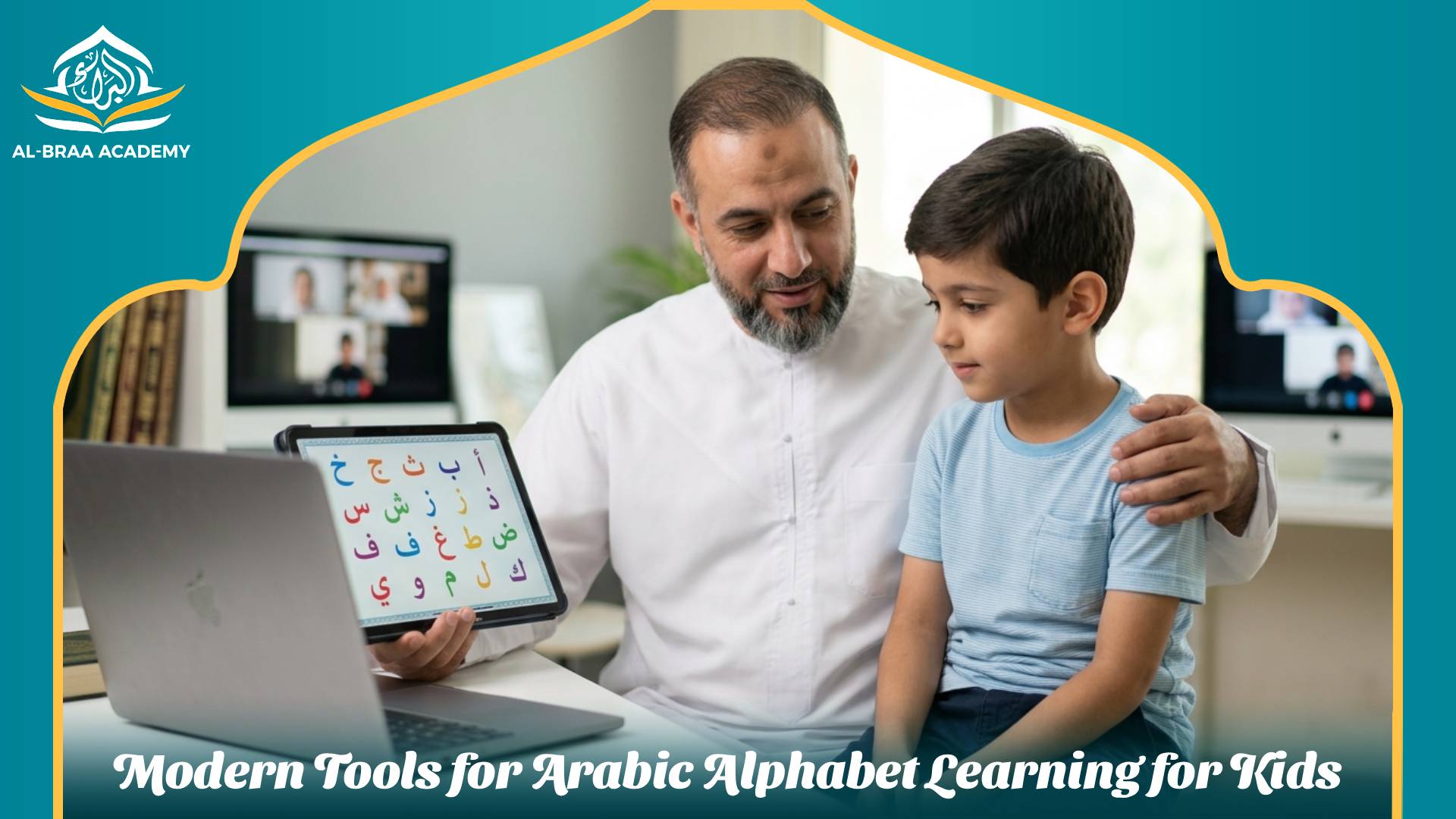
Learning the Arabic alphabet has become more accessible and engaging thanks to modern digital tools. At Al-Braa Academy, Arabic Alphabet for Kids courses use interactive apps and software designed specifically for young learners.
These tools allow children to trace letters on the screen, listen to correct pronunciations, and play educational games that reinforce letter recognition. This combination of visual, auditory, and interactive learning helps children retain knowledge more effectively and enjoy the process of mastering Arabic letters.
Using an Arabic Alphabet Learning App for Kids, children can repeat letters as many times as needed, hear the sounds of each consonant, and practice writing in different styles such as Naskh or Kufic.
The apps also include quizzes, animated exercises, and rewards to motivate learners to progress steadily. For busy parents, these apps provide a convenient way to support their child’s learning from home, ensuring that progress is consistent even outside traditional classroom settings.
At Al-Braa Academy, educators supplement app-based learning with live guidance, explaining tricky letters and sounds, demonstrating proper writing techniques, and correcting mistakes in real-time.Users can also explore Arabic Language Tutor Online for more related options.
This hybrid approach ensures that children are not just interacting with technology but also receiving expert instruction. By combining digital tools with structured lessons, the academy prepares children to read, write, and understand Arabic confidently, laying a solid foundation for future Quranic studies and language proficiency.
Interactive Methods for Teaching Arabic Alphabets for Kids
Engaging children in learning the Arabic alphabet requires creativity and interactivity. At Al-Braa Academy, Arabic Alphabets for Kids courses are designed with hands-on activities that make learning fun and memorable. Teachers use storytelling, songs, and games to introduce letters and their sounds.
Children are encouraged to participate actively, repeating letters aloud, tracing them, and even acting out words that start with certain letters.
Interactive teaching helps children understand the connection between letters, sounds, and words. For example, when learning the letter “ب” (Ba), children might associate it with a common word like “باب” (door), drawing or tracing it as they say it aloud.
Such methods reinforce both recognition and pronunciation. Educators at Al-Braa Academy also incorporate group activities where learners practice together, building confidence, and improving social interaction skills.
Additionally, digital tools complement in-person instruction. Through Arabic Alphabet Learning App for Kids, children can access animated letters, interactive quizzes, and guided exercises that adapt to their learning pace.
Combining traditional methods with technology ensures children gain a comprehensive understanding of the Arabic alphabet while keeping them motivated. This approach encourages consistent practice, leading to long-term retention and preparing children for advanced reading and writing in Arabic.
Benefits of Learning Arabic Alphabets for Kids
Mastering the Arabic alphabet early provides children with several academic, cultural, and religious benefits. Arabic Alphabet for Kids courses at Al-Braa Academy not only teach letters and sounds but also develop critical skills in memory, concentration, and cognitive processing.
Learning the alphabet enables children to read Arabic books, understand Quranic text, and communicate in a globally spoken language, connecting them to a rich cultural and religious heritage.
Children who learn Arabic alphabets can also progress more easily to Quran and Arabic Lessons Online. By understanding each letter’s sound and shape, they gain confidence in reading the Quran and other Arabic texts.
This foundation ensures that they are not just memorizing words but also comprehending meaning, which strengthens both language and spiritual understanding. Additionally, early exposure to Arabic letters encourages curiosity, literacy, and academic excellence.
At Al-Braa Academy, structured programs for Arabic Alphabets Learning for Kids emphasize consistency and repetition. By combining interactive apps, engaging lessons, and supportive teachers, children acquire reading and writing skills effectively.
This solid foundation ensures long-term success, enabling learners to explore more advanced Arabic language courses, understand religious texts, and appreciate the cultural significance of the Arabic alphabet in daily life.
Techniques to Improve Arabic Alphabet Retention for Kids
Helping children remember the Arabic alphabet effectively requires consistent practice and engaging techniques. At Al-Braa Academy, Arabic Alphabet for Kids lessons incorporate a combination of visual, auditory, and kinesthetic learning.
Children are encouraged to trace letters with their fingers, listen to correct pronunciations, and repeat them aloud. These multisensory activities strengthen memory and ensure that letters are retained more easily.
Repetition is another essential technique. Short daily sessions focusing on a few letters at a time are more effective than long, infrequent lessons. Teachers at Al-Braa Academy guide children in reviewing previously learned letters regularly, combining it with new material for balanced progression.
Pairing letters with common words or objects, like associating “م” (Meem) with “ماء” (water), helps create mental connections that make learning fun and meaningful.
In addition, songs, rhymes, and simple stories can reinforce letter recognition. Children naturally enjoy musical or narrative learning, making it easier for them to remember sounds and shapes. By integrating these techniques, Al-Braa Academy ensures that learners develop strong foundational skills, preparing them for reading, writing, and understanding Arabic in both academic and religious contexts. With patience and structured methods, children can confidently master the Arabic alphabet and move smoothly to advanced Arabic and Quranic lessons.
Common Mistakes to Avoid When Learning Arabic Alphabet for Kids
While learning the Arabic alphabet, children often make common errors that can slow progress. Al-Braa Academy addresses these issues proactively, guiding teachers and parents on how to correct them. One frequent mistake is skipping proper letter pronunciation, which can affect reading skills later. Teachers emphasize listening to accurate pronunciations and imitating them precisely.
Another error is inconsistent practice. Learning letters sporadically without daily reinforcement can lead to forgetting previously learned material. Arabic Alphabet for Kids lessons at Al-Braa Academy are structured to balance learning new letters with reviewing old ones.
Overloading children with too many letters at once is also discouraged, as it can create confusion and reduce retention. Instead, lessons focus on small, manageable groups of letters.
Writing mistakes are common, too. Each letter can change shape depending on its position in a word, and children must practice carefully to distinguish these variations. Using tracing exercises and guided writing, learners become confident in forming letters correctly.
By avoiding these common pitfalls, children at Al-Braa Academy develop a solid foundation in reading, writing, and understanding Arabic, ensuring long-term success and readiness for advanced Arabic and Quranic studies.
Incorporating Arabic Alphabet Learning into Daily Life

Reinforcing Arabic alphabet skills outside the classroom is key to mastery. At Al-Braa Academy, educators encourage parents to integrate learning into daily activities. Simple practices like reading labels, writing short words, or listening to Arabic songs can immerse children in the language naturally. This everyday exposure helps solidify the knowledge acquired in lessons.
Practical applications include labeling household items with Arabic letters, practicing simple greetings, or using flashcards during playtime. Children can also be asked to recognize letters in books or on digital apps, strengthening recognition skills. By making learning interactive and part of their daily routine, children develop both reading confidence and a deeper appreciation for the language.
At Al-Braa Academy, lessons are designed to blend structured teaching with real-life applications. Educators provide parents with guidance on simple, effective ways to practice Arabic at home, ensuring that learning continues beyond formal sessions.
Incorporating Arabic alphabet learning into daily life nurtures curiosity, reinforces skills, and prepares children for more advanced studies in Arabic and Quranic reading. This approach ensures children retain their knowledge and develop a lifelong connection to the language.
Frequently Asked Questions About Arabic Alphabet for Kids
Learning the Arabic alphabet is a crucial step for children, and many parents have questions about the best ways to teach, practice, and retain letters effectively for long-term success.
At what age should children start learning the Arabic alphabet?
Children can start learning the Arabic alphabet as early as ages 3 to 4 with simple letters and sounds. Al-Braa Academy recommends beginning with familiar letters through songs, games, and tracing exercises. Starting young helps develop recognition, pronunciation, and early writing skills, building a strong foundation for reading Arabic words and Quranic texts later on.
How often should kids practice the Arabic alphabet at home?
Daily practice is ideal, even if only for 10–15 minutes. Arabic Alphabet for Kids lessons at Al-Braa Academy encourage short, consistent sessions to reinforce memory. Regular practice ensures letters are retained, strengthens reading fluency, and keeps children motivated.
What tools can help children learn the Arabic alphabet effectively?
Visual aids, flashcards, tracing worksheets, and interactive apps are very effective. Al-Braa Academy uses a combination of these tools in their Arabic alphabet learning programs for kids, combining audio, visual, and hands-on activities to enhance engagement and understanding.
How can I make learning the Arabic alphabet fun for my child?
Incorporating games, songs, storytelling, and interactive exercises makes learning enjoyable. Children respond well to creative methods like letter scavenger hunts, matching games, and coloring activities. Al-Braa Academy emphasizes fun-based learning to keep children interested and enthusiastic.
Can my child learn the Arabic alphabet online?
Yes, online platforms like Al-Braa Academy provide structured Arabic alphabet lessons for kids. These lessons combine live sessions, interactive exercises, and digital resources, allowing children to learn effectively from home while receiving guidance from experienced teachers. Many students pair this with our arabic lessons kids to round out their learning.
In conclusion, Arabic Alphabet for Kids at Al-Braa Academy empowers children to start their journey into Quranic studies confidently. Through fun, interactive learning and consistent practice, children not only master the Arabic letters but also gain the tools necessary for reading and understanding the Quran.
These lessons instill confidence, discipline, and a strong love for learning that supports their future spiritual growth and Quranic education.
Learn More: